
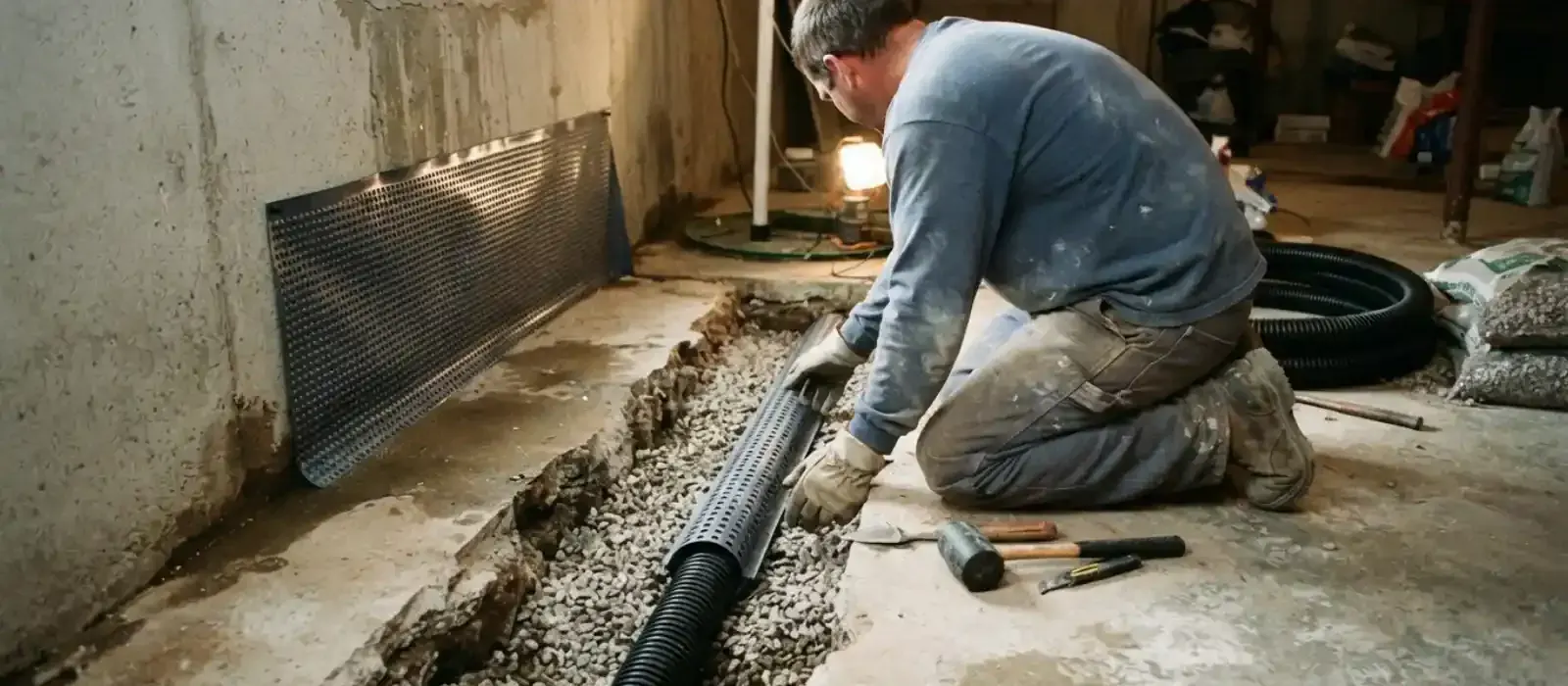
Find the water source before you price anything
A wet basement has one of a handful of causes. Surface water pools against the wall because of poor grading or gutters. Groundwater pushes up through the floor joint. A crack lets water through the wall. A failed sump pump or a plumbing leak mimics a seepage problem.
The cheap fix for the first cause is downspout extensions and regrading. The cost climbs when the source is groundwater, because the system has to collect water under pressure and carry it away. Pay for the diagnosis first, since the wrong method wastes the whole budget.
Watch for white mineral crust on concrete, a damp line at the floor edge, or water that appears days after a storm. Each one points to a different branch.
What Clearfield records say about water and foundations
The Utah Geological Survey states that shallow groundwater, generally within 10 feet of the surface, can occur anywhere in Utah, is more likely in low-lying valley areas and near waterways, and changes with climate, seasonal precipitation and irrigation. It can seep into basements. So a basement that stays dry for years can still leak after a wet spring or a heavy irrigation season, and a plan should assume the water level moves.
Clearfield City Code 10-1-4 on subsurface water requires footings to sit at least two feet above the highest water table, or a foundation drain that carries water to a positive drainage system. Grading must also direct water away and must not trap it against basement walls. If your home has no foundation drain, or the grading slopes toward the wall, that gap is a direct reason water shows up.
NOAA normals for the Ogden area put annual precipitation near 16.4 inches, with April at about 1.97 inches and May at about 2.17. Spring is when the water arrives, so schedule work in the dry months or expect to wait out the season.
Neither the state survey nor the city publishes a depth-to-groundwater figure for Clearfield, so a sealed or drained basement cannot be promised dry on the strength of any map.
Source: Utah Geological Survey PI-105 Shallow Groundwater Hazard in Utah (state), Clearfield City Code 10-1-4 (city), and NOAA NCEI 1991-2020 Normals (federal).
Which method fits which problem
Price follows the method, and the method follows the cause. Use this table to match your symptom to the right branch.
| Cause | Typical fix | Cost direction | Limit |
|---|---|---|---|
| Gutters and grading | Downspout extensions, regrade | Lowest | Does nothing for groundwater |
| Small crack, no pressure | Injection or patch | Low | Cracks can reopen as soil moves |
| Seepage at floor edge | Interior drain tile with sump | Moderate to high | Manages water, does not keep it outside |
| Wall leaking under pressure | Exterior excavation and membrane | Highest | Disrupts landscaping, slabs, and fences |
| Failed sump pump | Replace pump, add backup | Low to moderate | Not a cure for a wet wall |
Many basements need two of these together, such as an interior drain plus a sump pump.
What moves a waterproofing quote
Ask each contractor to break the quote into the factors below so you can compare scope and not just the bottom line.
- Linear feet of wall or floor edge
- Interior drain systems are priced by the length of wall they run along. A larger footprint means more concrete cutting and more tile.
- Exterior or interior
- Digging down to the footing requires excavation, membrane and backfill. Interior work stays inside, but it handles water instead of blocking it.
- Sump pump and discharge
- Interior systems usually need a pit, a pump and an outlet, and the outlet cannot go to the sanitary sewer.
- Finishes in the way
- Drywall, flooring and framing must be removed and replaced. A finished room can double the labor.
- Access and site
- Tight yards, decks, a driveway on the wall or a neighbor's fence all change the equipment and time.
Insurance usually responds to sudden and accidental water, such as a burst pipe, and often excludes seepage, groundwater and wear. Check your policy and ask about a water backup endorsement before you plan on a claim.
To have a licensed plumber trace the water and price the right branch, call (801) 207-7520.
Not sure which branch your basement is on? Call the Clearfield Express line, open 24/7, and describe where the water appears.
Call (801) 207-7520Radon and mold: costs people forget
Waterproofing changes the air in a basement as well. The EPA action level for radon is 4 pCi/L, and Utah reports that about 1 in 3 tested homes has an elevated level. Davis County Health Department, based in Clearfield, offers seasonal radon tests, and the county says most homes can mitigate for about $1,500. Treat that as the county's estimate, not a quote.
Test the lowest living level before and after any sealing work. If drywall or carpet stayed wet for more than 24 to 48 hours, the CDC says to remove porous items and not to rely on routine mold sampling. Never mix bleach and ammonia while cleaning.
What to ask a contractor before you sign
Ask what water source the contractor believes is the cause and how they confirmed it. A reply of just that the basement needs a system is a warning sign. Ask whether the plan assumes a sump pump, where the water will be discharged, and whether the bid includes patching and finish work.
Ask what the guarantee covers and what it excludes. A transferable warranty on a drain system is worth reading in full. Ask too what happens if the pump loses power.
When waterproofing is not the answer
Some wet basements are plumbing problems. A dripping supply line, a leaking water heater, a failed shower pan above, or a backed-up floor drain will not respond to a drain tile. If the water appears near a pipe or after you run a fixture, a plumber should look at it first.
A pump-only solution is also not waterproofing. If your main need is a pit and a pump, see our sump pump repair page for how those jobs work.
Nearby homes we visit
Homeowners in Layton and Sunset usually start with the same question: is this seepage or a leak? Answering that early is what keeps the quote honest.
Waterproofing cost questions
Does Davis County test for radon for free?
Davis County Health Department, at 22 S State St in Clearfield, offers free seasonal radon tests. Sign-ups run October 1 to March 1, and the county notes a wait of two to six weeks.
Kits are also available through radon.utah.gov. The EPA action level is 4 pCi/L.
Is interior or exterior waterproofing more expensive?
Exterior work usually costs more because it requires excavation, membrane and backfill along the foundation. Interior drain systems are cheaper in most homes but manage water instead of keeping it out.
The right choice depends on the source of the water, which should be confirmed first.
Can I send the sump pump water to the sewer?
No. The North Davis Sewer District ordinance bars groundwater sump pump discharges, storm water and roof runoff from the sanitary sewer.
Plan an outside outlet and confirm it with Clearfield Public Works.
Will waterproofing guarantee a dry basement?
No contractor can promise that. Shallow groundwater moves with climate, precipitation and irrigation, so a wet year can test any system.
Ask what the guarantee covers and what it excludes, and keep the pump maintained.
When should I schedule waterproofing in Clearfield?
Dry months make excavation and concrete work easier. April and May are the wettest stretch in the normals, so do not wait for the first spring flood.
Book the diagnosis early, then schedule the work around weather and ground conditions.
What does a plumber do for a wet basement?
A plumber checks supply lines, drains, the water heater, the sump pump and the discharge for leaks that mimic seepage. If the water is groundwater, the plumber can set an interior drain and pump.
Foundation excavation may be a separate trade, and we will say so honestly.