
When a leaking water heater is an emergency
Water coming from the bottom seam of the tank, or pooling faster than a towel can absorb, is an active leak. Treat it as urgent. A tank holds a lot of water, and a basement, finished closet or garage wall can soak through before anyone notices.
Do these three things first. Close the cold inlet valve on top of the heater, turn the breaker off (electric) or the gas control knob to off (gas), and stay out of standing water if the floor outlet or panel is close. A hot tap opened upstairs lets the tank drain and takes the pressure off the leak.
If you smell gas, do not touch switches or phones inside. Leave the building and call 911 or the gas utility from outside. After that, call us.
A leak at 2 a.m. gets the same handling as one at noon: the line answers, a licensed plumber is dispatched, and we book the first same-day or after-hours visit available. We do not promise a clock time, because that depends on where the plumber is when you call.
Reading the symptoms before anyone opens a panel
What the heater does tells a plumber where to start. These are the patterns that come up most.
No hot water at all
On an electric tank, the usual culprits are a tripped breaker, a high-limit reset button that popped, or a burned-out upper element. On a gas tank, a pilot that will not stay lit often points to a worn thermocouple, a dirty burner or a draft problem in the flue. Nothing here needs a new heater unless the tank is also leaking.
Warm, then cold fast
A shower that runs warm for a few minutes and fades usually means one dead element, a broken dip tube mixing cold feed into the top of the tank, or a tank full of sediment. All three are repairs. The sediment case also tells you the heater is aging, so ask about flushing.
Which fault, which fix
This is the decision order a plumber works through on site. It also shows you where the honest line between repair and replacement sits.
| Fault found | Typical repair | Repair makes sense when | Think replacement when |
|---|---|---|---|
| Dead heating element (electric) | Test with a meter, swap the element and gasket | Tank is dry and the other parts test fine | Tank is well past 10 years and corroded |
| Pilot will not stay lit (gas) | New thermocouple, clean burner and pilot tube | Flue draws properly and no soot | Rusted burner chamber or backdrafting flue |
| Relief valve weeping | Replace valve, check system pressure | Pressure spikes can be fixed with an expansion tank | Tank has also started seeping at the seam |
| Leaking drain valve or fittings | Replace valve, nipples or flex connectors | Water stops after the part is changed | Fittings are fused by corrosion to the tank |
| Water from the tank body | No repair exists | Never | Always, because a rusted shell cannot be patched |
The last column is a guide, not a rule. Age, parts availability and the condition of the venting all count.
What Clearfield's homes and water do to a tank
The median home in Clearfield was built in 1989, and about 3,988 of the city's 12,042 housing units date from 1990 through 2009. In many of those houses the original heater is long gone, so the tank you have is probably the second or third. Ask the plumber to read the serial number: the date is coded in it, and it tells you whether you are repairing a heater or nursing one.
Clearfield's own 2025 water quality report lists total dissolved solids of 324 to 400 ppm. Those dissolved minerals settle out as scale on the bottom of a tank and on elements, which is why elements burn out and tanks rumble. The city's report gives no hardness figure, so test your tap or ask Clearfield City for its annual report. Weber Basin, which supplies most of the city's water, reports a district-wide hardness range of 10 to 18 grains per gallon.
Source: U.S. Census Bureau ACS 2020 to 2024, Clearfield City 2025 Consumer Confidence Report, and Weber Basin Water Conservancy District 2025 report.
Standing in water or stuck with cold showers? The line is open 24/7.
Call (801) 207-7520How the plumber finds the fault
Diagnosis starts with the safe stuff. The plumber checks the breaker, the high-limit reset and the gas control setting, then confirms water is reaching the tank. Plenty of no-hot-water calls end here, with a reset and an explanation.
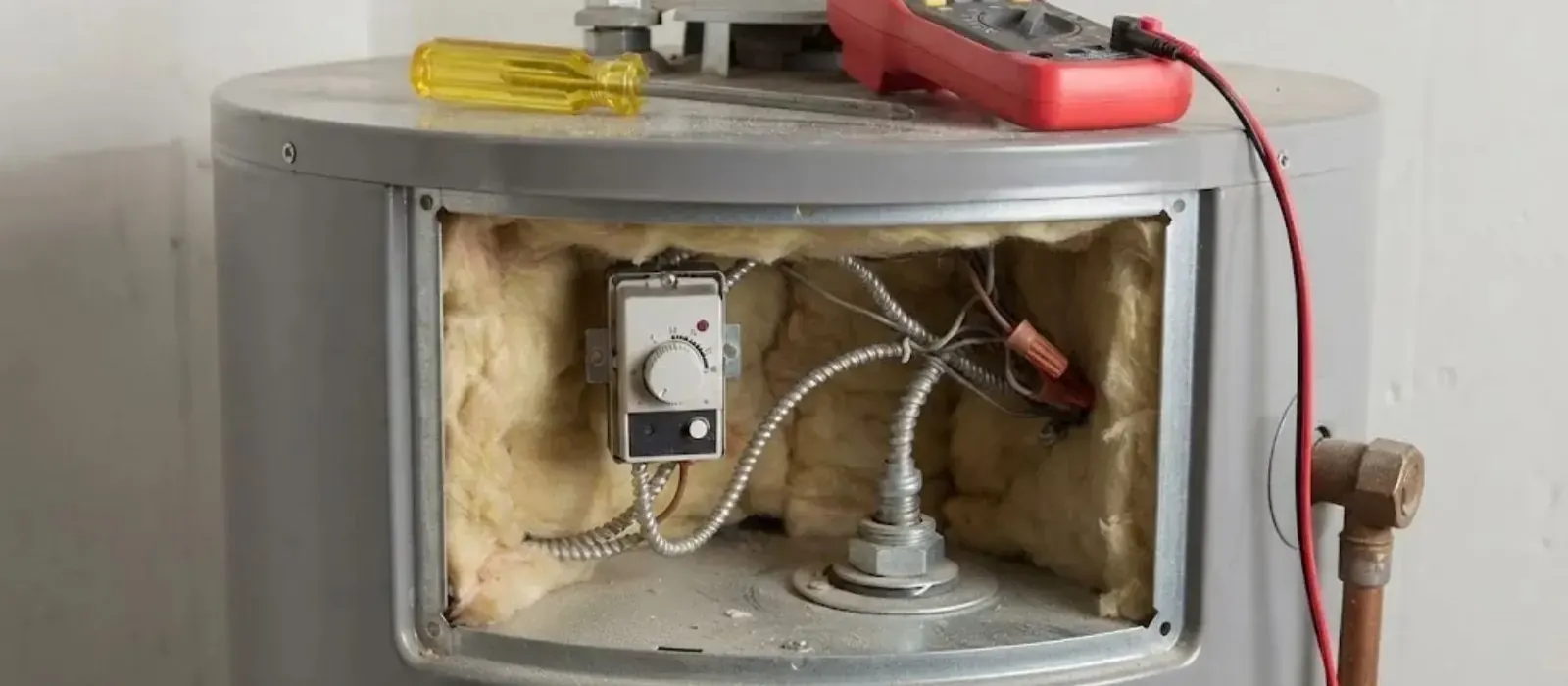
On an electric unit the next tool is a multimeter, used to test voltage at the terminals and continuity through each element. On a gas unit the plumber looks at flame color and shape, reads the thermocouple output and checks the flue for draft. A smoke test at the draft hood shows whether exhaust is rising or spilling into the room.
Water heater leak: repair the part or retire the tank
Most water heater leak calls turn out to be one of five spots: the relief valve, the drain valve, the inlet or outlet connections, the anode rod port or the tank itself. The first four are repairs. The fifth is not.
A relief valve that drips after every heating cycle is often reacting to thermal expansion. When a house has a pressure reducing valve or backflow device, heated water has nowhere to go, so pressure climbs until the valve opens. An expansion tank fixes the cause, while replacing the valve alone just resets the timer.
If the plumber finds moisture creeping down from the seam or the insulation jacket is soaked, the steel shell has failed. At that point water heater replacement is the safer spend, and the same visit can often cover it when stock allows. Slow leaks that do not come from the heater at all, such as a supply pipe in the wall, belong to leak detection.
What decides the cost of a water heater repair
Repair bills swing widely because the same symptom can hide a cheap part or a costly one. We give you a clear price before work starts. These are the factors that move it.
- The part itself
- An element, thermocouple or relief valve is small money. A gas control valve or a tankless heat exchanger is a much bigger part.
- Fuel and design
- Electric tanks, atmospheric gas tanks, power vent units and tankless heaters each have different parts and different labor.
- Access
- A heater in an open garage is quick. One packed into a closet, attic or crawlspace takes longer to reach and to work around.
- Age and warranty
- A heater still inside its manufacturer warranty may qualify for a part credit. An old one can need parts that are hard to find.
- What else turns up
- Corroded venting, a missing drain pan or an unsafe gas connector may need fixing before the heater runs again.
Homeowner policies usually cover sudden and accidental water damage, such as a tank that bursts and floods a room, but not wear and tear, so the heater itself is rarely covered. Check your policy and keep photos of the damage.
Not sure whether a part or a tank is the problem? Call (801) 207-7520 and describe what you see.
Winter, garages and the Clearfield cold
NOAA normals for the Ogden-Hinckley airport station, the closest with the data, show about 121 days a year with lows at or below freezing and a December through February average low near 23 degrees. Many Clearfield heaters sit in garages, where cold incoming water makes marginal elements and thermostats quit.
Gas heaters add one more winter job. The gas utility advises keeping the meter and exhaust vents clear of snow and ice, because blocked venting is a carbon monoxide risk. Neighbors in Layton and Sunset get the same weather, and the same advice applies.
When it is not a repair job
Some calls end in a recommendation to replace, and we would rather say so than sell you a part. The Department of Energy puts the life of a storage tank heater at about 10 to 15 years. A tank in that range with a rusted shell, repeated failures or a backdrafting flue is a poor place to put more money.
Hot water that is only missing at one faucet is not the heater at all. That points to a failed cartridge or mixing valve, which is a faucet repair. A tankless unit throwing error codes may need descaling rather than parts. If you are weighing a swap to tankless, the tankless water heater page explains the trade-offs.
Water heater repair questions from Clearfield homeowners
Do you handle water heater repair emergencies at night or on weekends in Clearfield?
Yes. The dispatch line runs 24/7, including nights, weekends and holidays, and a licensed plumber is sent to active leaks and total loss of hot water. We book the first same-day or after-hours visit open and do not quote an arrival time, because it depends on the plumber's location when you call.
Shut the cold supply and the power or gas first, and the plumber can start from there.
Why is my water heater leaking from the bottom?
Water at the bottom has three common sources. A dripping drain valve or a leaking relief valve discharge pipe can run down the outside and pool. A cracked or rusted tank shell leaks from the seam.
A plumber wipes the tank dry, finds where fresh water appears and decides. If it comes through the shell, no repair holds and the tank needs replacing.
Why do I have no hot water but the heater seems to be running?
On an electric tank, one failed element or a tripped high-limit switch can leave the unit humming but cold. On gas, a pilot or thermocouple problem stops the burner while the tank sits idle.
A broken dip tube is another cause. It sends cold feed water straight to the outlet, so what comes out is lukewarm at best.
Is it worth repairing a water heater that is over ten years old?
Sometimes. The Department of Energy puts storage tank life at about 10 to 15 years, so a heater near the end of that range is a gamble for anything but a cheap part. A thermostat or element on a sound tank is usually worth doing.
When the tank itself is rusting, the money is better spent on a new heater.
My relief valve keeps dripping. Is that dangerous?
The valve is there to release excess heat or pressure, so a drip means it is doing something. Often the cause is thermal expansion in a closed plumbing system, not a bad valve.
Never cap or plug the discharge pipe. A plumber can check house pressure, test the valve and add an expansion tank when that is the real cause.
Will the plumber check the venting on a gas heater?
Yes. Looking at the vent connection, draft hood and flexible gas line is part of finding the fault, and anything unsafe gets explained to you. Venting or connector work may be separate, and you agree the price before it starts.