
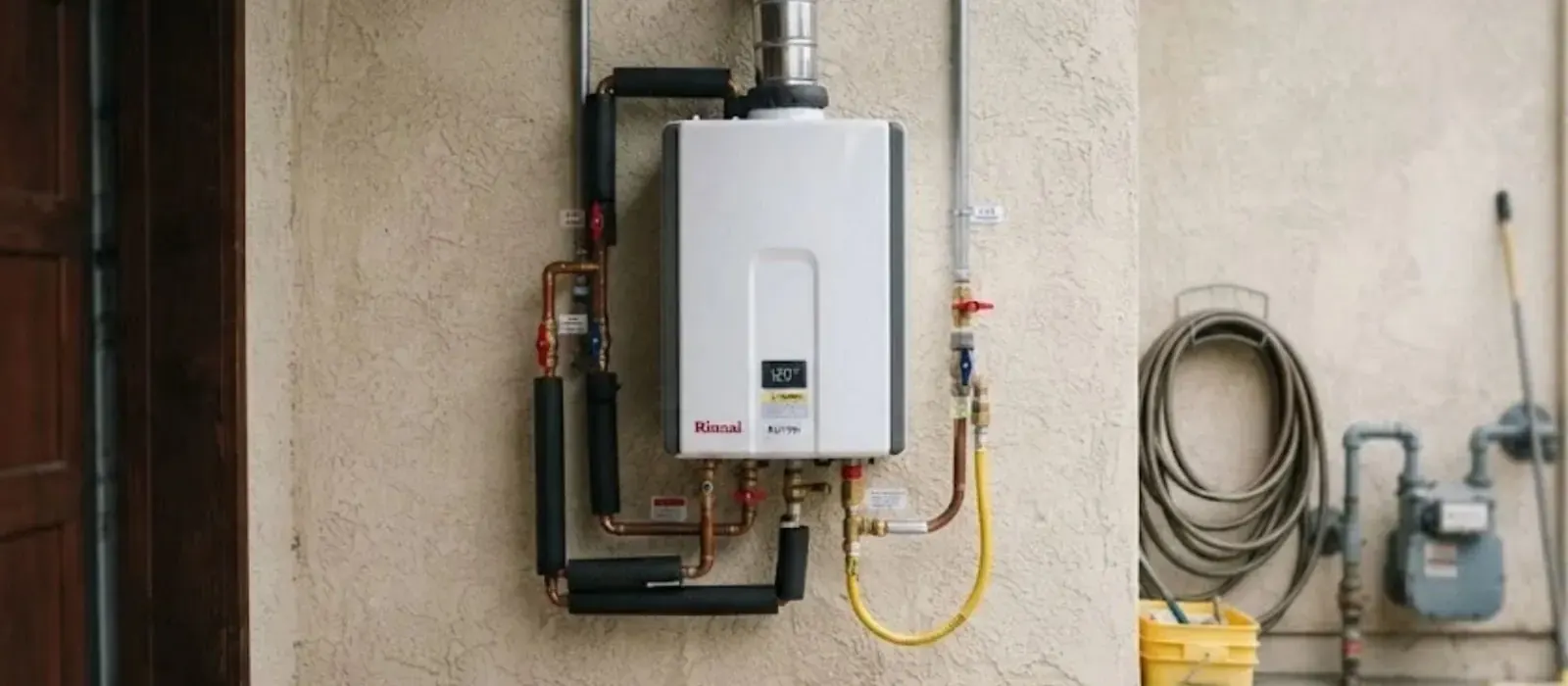
What actually changes when the tank goes away
A tank heater keeps about 40 to 50 gallons hot all day and night. A tankless unit keeps nothing in reserve. When you open a tap, a flow sensor tells the burner to fire, and water passes through a heat exchanger on its way to the fixture.
The Department of Energy puts tankless efficiency gains at 8 to 34 percent over a storage unit, depending on how much hot water a home draws. It also lists a service life of about 20 years, against 10 to 15 for a tank. Those gains are real, but they cost more upfront and they depend on the unit being fed and vented correctly.
The limit is flow. Each unit raises a set number of gallons per minute by a set number of degrees, so a shower, dishwasher and washer running together can overload a small one.
Tankless or tank: how the choice usually falls
Neither type wins everywhere. Use the situation in your house to decide, not the brochure.
| Situation | Better fit | Why |
|---|---|---|
| Small household, spread-out showers | Tankless | Little simultaneous demand and no standby loss |
| Large family, back-to-back showers and laundry | Tank or a large tankless | A single small unit loses temperature under overlap |
| Gas line is half-inch and runs far | Tank, unless the line is upgraded | Tankless burners need a bigger gas supply |
| Water is hard and no softener is planned | Tank, or tankless with a softener | Scale chokes the heat exchanger |
| Closet or utility room is tight | Tankless | Wall-mounted unit frees the floor |
| Short-term home, lowest upfront cost | Tank | Tankless costs more to buy and to vent |
Our plumbers walk through this at your house. A like-for-like tank swap is covered on the water heater installation page.
Hard water is the Clearfield-specific risk
Clearfield City buys most of its water from Weber Basin Water Conservancy District and adds water from city wells at high-demand times. The city's 2025 water quality report lists total dissolved solids between 324 and 400 ppm but does not state hardness. Weber Basin's own report says hardness across its supply can range from 10 to 18 grains per gallon.
That matters because the Department of Energy notes that some manufacturers require a softener once hardness passes roughly 8 to 14 grains per gallon. Scale builds inside the heat exchanger and slowly narrows the passage. Test your own tap, ask Clearfield City for its annual water quality report, and read your unit's warranty terms before you choose. Our water softener and filtration page covers the treatment side.
Source: Clearfield City 2025 Consumer Confidence Report, Weber Basin Water Conservancy District 2025 report and U.S. Department of Energy Building America tankless guide.
Flushing and descaling: the maintenance that decides how long the unit lasts
Descaling is the one task every tankless owner ends up needing. The plumber closes the gas and water to the unit, connects hoses to the service valves, and circulates a descaling solution through the heat exchanger with a small pump. Clean water then rinses the unit, and the inlet screen is cleaned.
How often depends on the water. The Department of Energy says manufacturers set flush intervals anywhere from twice a year to once every three years. In hard-water homes the short end of that range is the safer guess.
Warning signs are plain. Hot water arrives slowly or runs lukewarm. The unit rumbles or ticks while it fires. An error code keeps returning after a reset. A unit without isolation valves needs them added before it can be flushed.
Skipped flushes shorten the unit's life and can void a warranty that requires documented service, so keep the invoice.
Code, permits and the gas side of a tankless install
Clearfield City's 2026 design criteria list the 2024 International Plumbing Code as the adopted plumbing code, effective July 1, 2026. Clearfield's permit guidance lists water heater installations and replacements as permit work.
A gas tankless unit also needs a vent and a gas line sized for its higher burner load. Ask the plumber to confirm the existing line can carry it before the unit is ordered, since a line that is too small turns into a second job.
Not sure whether your unit needs a flush or a repair? Call (801) 207-7520 and describe what you see and hear.
Call (801) 207-7520Gas, venting and permits before a unit goes on the wall
Gas tankless units burn fuel fast. The Department of Energy guide notes the gas line serving one will usually need to be 3/4 inch, though the manufacturer's sizing table and the plumbing code decide it. A line sized for an old tank is often too small.
Condensing units add a condensate drain, and every unit needs venting that is listed for that model. Mixing vent parts between brands is not allowed. Enbridge Gas also asks owners to keep meters and exhaust vents clear of snow and ice, so think about snow drifts before choosing a wall vent location.
Clearfield City's permit list names water heater installations and replacements, so ask the Clearfield City building department what applies to your unit. Gas appliance work is also outside the minor-repair exemption in Utah law, which is why a licensed plumber should do it. Smell gas? Leave the building and call 911 or the gas utility from outside.
Diagnosing a tankless unit that misbehaves
The plumber starts with the display. Error codes point at ignition, flow, venting or exchanger temperature. Next comes a flow check at several fixtures to see whether the unit fires at low volume.
Then the supporting parts get tested. The inlet screen is pulled and checked for sediment, and a manometer reads gas pressure while the burner runs. The vent run is checked for blockage, and the heat exchanger for scale.
Many complaints turn out to be plumbing, not the unit. A faulty mixing valve, a crossed hot and cold line, or a recirculation loop feeding cold water back are common causes of the cold water sandwich, where a burst of cold comes between two hot bursts. A tank unit that has simply stopped heating belongs on our water heater repair page.
What shapes the price of a tankless job
We give a clear price before work starts. These factors move it more than anything else.
- Unit capacity and fuel
- A larger gas unit or a condensing model costs more than a small electric one, and electric units may need a heavier circuit.
- Gas line upgrade
- Moving from a half-inch line to a larger one adds pipe, labor and a pressure test.
- Venting route
- A short wall run is simple. A long run through an attic or a re-use of old flue parts is not.
- Water treatment
- A softener or a scale filter protects the exchanger and adds equipment to the quote.
- Permit and removal
- Permit paperwork, removing the old tank and any required supports or drain parts are part of the job.
Homeowner insurance usually covers sudden and accidental water damage, such as a burst supply line. It rarely pays for wear, scale or an upgrade you choose. Read your policy or ask your agent before you file.
Enbridge Gas runs ThermWise rebates for qualifying gas tankless units, and requests must be postmarked within six months of installation. Check the current amount and rules with the program. For a quote, call (801) 207-7520.
When tankless is the wrong answer
We will say so if your home is a poor match. Very high simultaneous demand, a gas line that cannot be upgraded, or hard water with no plan for treatment can leave you disappointed. A modern tank is not a failure.
A tankless unit also will not fix low pressure, a leaking supply line or a failing valve. Those are separate problems. If hot water fades house-wide, we look at the pipes first. Homeowners in Layton and Syracuse book the same planning visit.
Tankless questions we hear from Clearfield homeowners
How long does a tankless water heater last in Clearfield, UT?
The Department of Energy puts tankless life at about 20 years, versus 10 to 15 for a storage tank. Hard water and skipped flushes cut that down. In Clearfield, where Weber Basin water is reported at 10 to 18 grains per gallon, a flush schedule and a softener plan are what protect the number.
Is a tankless water heater worth it with hard water?
It can be, if you plan for scale. Hard water leaves mineral buildup inside the heat exchanger, which restricts flow and shortens life. Many manufacturers want a softener above a certain hardness. Test your tap first, then decide whether to add a softener or keep a tank.
How often should a tankless unit be flushed?
The manufacturer sets the interval, and the Department of Energy says it ranges from twice a year to once every three years. Harder water points toward the shorter interval. The plumber circulates a descaling solution through the heat exchanger and then rinses it with clean water.
Can I swap my tank for a tankless unit without changing the gas line?
Sometimes, but often not. Tankless burners draw more gas than a tank, and the Department of Energy notes the line usually needs to be 3/4 inch. The plumber measures the run and checks the manufacturer's table before promising anything.
Do I need a permit for a tankless water heater in Clearfield?
Clearfield City's permit list names water heater installations and replacements. Permit rules vary by job, so ask the Clearfield City building department what applies. The plumber handles the paperwork for work we perform.
Do you service tankless units that stopped working at night?
Our dispatch line is open 24/7, and same-day appointments are available when the schedule allows. Tell us the error code and what changed. If you smell gas, that is a different case. Leave the building and call 911 or the gas utility first.