
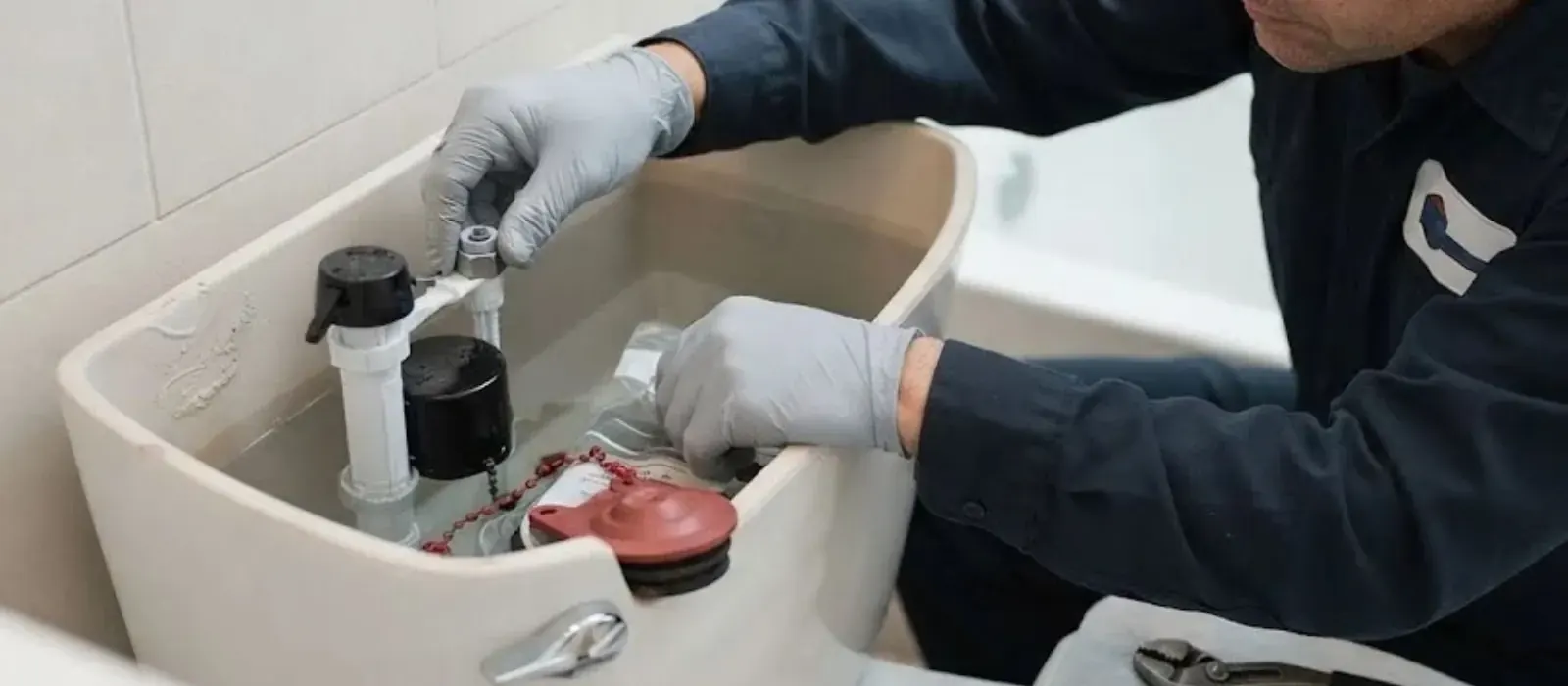
When a toilet overflow is an emergency
A toilet that spills over the rim, or keeps seeping after you close the valve, is an emergency because the water reaches subfloor and the room below fast. Treat it as urgent if the water smells like sewage, if it is dripping through a ceiling, or if it is near an outlet or a power strip.
Do this while you wait. Stop flushing, close the supply valve clockwise, and lift the tank lid to push the flapper down if the tank is still filling. Lay towels along the door, and do not step into standing water near electrical outlets.
Call at night or on a weekend and the same steps apply. We take after-hours toilet calls on the same dispatch line, and when a same-day appointment is open, the plumber can start with the cause rather than the cleanup.
What the toilet is telling you
Toilets fail in a handful of repeatable ways, and each one leaves a signature you can see or hear. Matching the symptom to the part saves a visit's worth of guessing.
Water around the base
A damp ring at the floor usually means the wax ring or flange seal has let go, but condensation from a cold tank and a weeping supply line look the same. Dry everything with a towel, then watch where the first bead returns.
If the toilet also rocks, the closet bolts may be loose or the flange may be broken or sitting below the finished floor.
Running, hissing, or phantom flushes
A toilet that refills every few minutes has a flapper that no longer seals, a fill valve that will not shut off, or a float set too high so water spills down the overflow tube. A steady hiss with no refill sound usually points at the fill valve.
Weak flush or slow bowl
Clogged rim jets, a low water level in the tank, or a partial blockage just past the trap all cut the flush. If only the toilet is slow, the problem is local. If the tub or floor drain gurgles when you flush, the blockage is further down.
Clearfield toilets and the 1994 line
Clearfield has 12,042 housing units and a median build year of 1989, so many homes date from when toilets used far more water. EPA says older toilets can use as much as 6 gallons per flush, while a WaterSense model uses 1.28 or less. Replacing an old unit can save nearly 13,000 gallons a year in an average home.
If yours needs a seal, flange work and a flapper all at once, the repair bill can approach the price of a new bowl. Then replacement is the sounder buy.
Utah Water Savers offers a rebate of up to $150 for a WaterSense toilet that replaces one made before 1994, limited to two per home. The program asks for photos and proof of purchase within 30 days, so ask us about the old toilet before it leaves the house.
Source: U.S. Census Bureau ACS 2020-2024, U.S. EPA WaterSense, and the Utah Division of Water Resources Utah Water Savers program.
How a plumber finds the cause
The plumber starts with the dry-towel test around the base and the supply line, then tests the tank. A few drops of food coloring in the tank, left for about ten minutes without flushing, show a flapper leak when color appears in the bowl.
Next comes the mechanical check: flapper chain length, fill valve height, float, and the overflow tube. For a base leak, the toilet is lifted to inspect the flange, bolts, and the floor underneath. A closet auger goes in for clogs, and a camera comes out only if other fixtures are backing up too. The same method applies in Sunset and Layton.
One honest limit: a visit to one bathroom cannot locate a leak inside a wall. If the water meter keeps moving with every fixture off, the plumber will say so and point you to leak detection.
The code behind a toilet swap
Swapping a toilet is fixture work, and Clearfield's permit guidance says replacing plumbing fixtures needs no permit. The fixture still has to connect the way the adopted code expects. Clearfield City's 2026 design criteria list the 2024 International Plumbing Code as the adopted plumbing code, effective July 1, 2026.
In practice that means a closet flange sitting at the right height and a supply stop that shuts fully. A plumber corrects a flange that is out of position instead of forcing the new bowl over it.
Toilet running, leaking, or backing up? Call (801) 207-7520 and a licensed plumber will talk you through the first steps.
Call (801) 207-7520Repair or replace: a decision guide
Parts are cheap and a good bowl can last decades, but a failed bowl never repairs well. Use this as a starting point, and the plumber will confirm on site.
| Situation | Usual fix | When it makes sense |
|---|---|---|
| Runs on and off | New flapper or fill valve | Bowl and tank are sound |
| Seeps at the base | New seal, bolts, or flange repair | Floor is solid and flange is intact |
| Cracked bowl or tank | Replace the toilet | A crack never holds, however it is patched |
| Clogs often, pre-1994 unit | Replace with WaterSense model | May qualify for the state rebate |
| Soft floor around the toilet | Subfloor repair, then reset | Water has been escaping for a while |
| Leak at the supply valve | New stop valve and braided line | Valve will not close fully |
Same-day appointments are offered when a slot is open, which matters most for the rows that involve active water.
Toilet repair and new installation
Installing a toilet means a new seal, a clean flange, a level bowl, new supply connections, and a leak test with several flushes. A first-time install or a move to a new location is more than a swap, because it can add drain and supply lines. If the faucet at the same vanity is dripping too, the plumber can handle faucet repair in the same visit.
Clearfield City says replacing plumbing fixtures does not need a permit, while new or replacement plumbing lines do. Utah licensing law also separates minor fixture repair from work that modifies waste or vent piping. Permit rules vary, so ask the Clearfield City building department before you relocate anything.
A toilet that leaks all day without a puddle
A silent flapper leak can run around the clock, and you may only learn about it from the water bill. Clearfield bills water on tiered conservation rates, so wasted gallons are not free. EPA suggests reading the meter, waiting two hours with no water use, and reading it again.
If the dye test and the meter point at the toilet, the repair is usually quick. If the meter still moves with the toilet shut off, the leak is elsewhere in the house or in the yard line.
Clogs that begin in the toilet
A plunger with a proper seal clears most single-fixture clogs. A closet auger reaches the trap without scratching the porcelain. Baby wipes and so-called flushable wipes are on North Davis Sewer District's never-flush list, because they pack together in the pipe and do not break down like paper.
If the clog keeps returning, the trap or the branch line may be partly blocked. A plumber can clear it with a cable, and for a stubborn line, sewer line cleaning reaches the main.
What decides the cost of a toilet repair
A toilet visit can be a ten-minute part swap or a half-day floor repair. These are the factors that move the quote, and the plumber states a clear price before work starts.
- What failed
- A flapper or fill valve is a small repair. A cracked bowl, a broken flange, or a rotted subfloor is a larger job.
- Age and parts
- Older toilets sometimes need parts that are discontinued, which tips the repair toward replacement.
- Flange and floor condition
- Pulling the toilet shows what the old seal was hiding, and a damaged flange adds work.
- Valves and supply lines
- Seized or corroded stop valves can be replaced in the same visit, which adds a part and time.
- Timing
- A same-day or after-hours visit is priced differently from a booked daytime appointment. You hear the number first.
Insurance generally responds to sudden and accidental damage, such as an overflow that soaks a floor, and generally not to a worn flapper or an aged seal. Check your policy and photograph the damage before cleanup.
Not sure which side of that line you are on? Call (801) 207-7520 and describe what you see.
When it is not the toilet
If the toilet gurgles when the washer drains, or water appears in a basement floor drain, the blockage is probably in the building sewer. North Davis Sewer District maintains the mains, while the property owner maintains the building sewer and its connection. A camera run shows which side the problem is on.
We do not treat septic systems, and Clearfield homes are on public sewer. For a toilet that is simply old, the fix may be a replacement rather than another repair.
Toilet questions Clearfield homeowners ask
Do you handle toilet repair emergencies at night or on weekends in Clearfield?
Yes. The dispatch line is open 24/7, and a licensed plumber can come out for an overflow, a base leak, or a toilet that will not stop running. We promise no arrival time. We do tell you what to shut off first.
Why does my toilet run on and off when nobody has used it?
Water is slipping past the flapper. The fill valve then tops the tank up every few minutes. Food coloring in the tank will show it. A new flapper or fill valve usually fixes it. Do it soon, because the waste adds up on your water bill.
Should I repair an older toilet or replace it?
If the bowl and tank are sound and the problem is a flapper, fill valve, or seal, repair makes sense. If the porcelain is cracked or the toilet clogs often, replace it. The same goes for a pre-1994 unit that needs several parts at once.
Do I need a permit to replace a toilet in Clearfield?
Clearfield City's permit guide says replacing plumbing fixtures does not need a permit, while new or replacement plumbing lines do. Moving a toilet usually adds lines. Permit rules vary, so ask the Clearfield City building department if you are unsure.
Does a new toilet qualify for a Utah Water Savers rebate?
The program offers up to $150 for a WaterSense toilet replacing one made before 1994, with a limit of two per home. It asks for photos and proof of purchase within 30 days. Check the program's current terms before you buy, and keep the old toilet until you have photographed it.
Can I fix a leaking toilet base myself?
Tightening a supply nut or swapping a flapper is a reasonable homeowner job. Pulling the toilet to replace the seal gets closer to the waste connection. Utah's licensing law exempts only minor fixture repair, and not work that modifies waste or vent piping, so call a plumber if you find a damaged flange.
The toilet and the shower are both slow. Is that a toilet problem?
Probably not. When two or more fixtures slow down together, the blockage is in the branch or the main line. A plumber can clear it and, if it keeps returning, run a camera to see the pipe.