
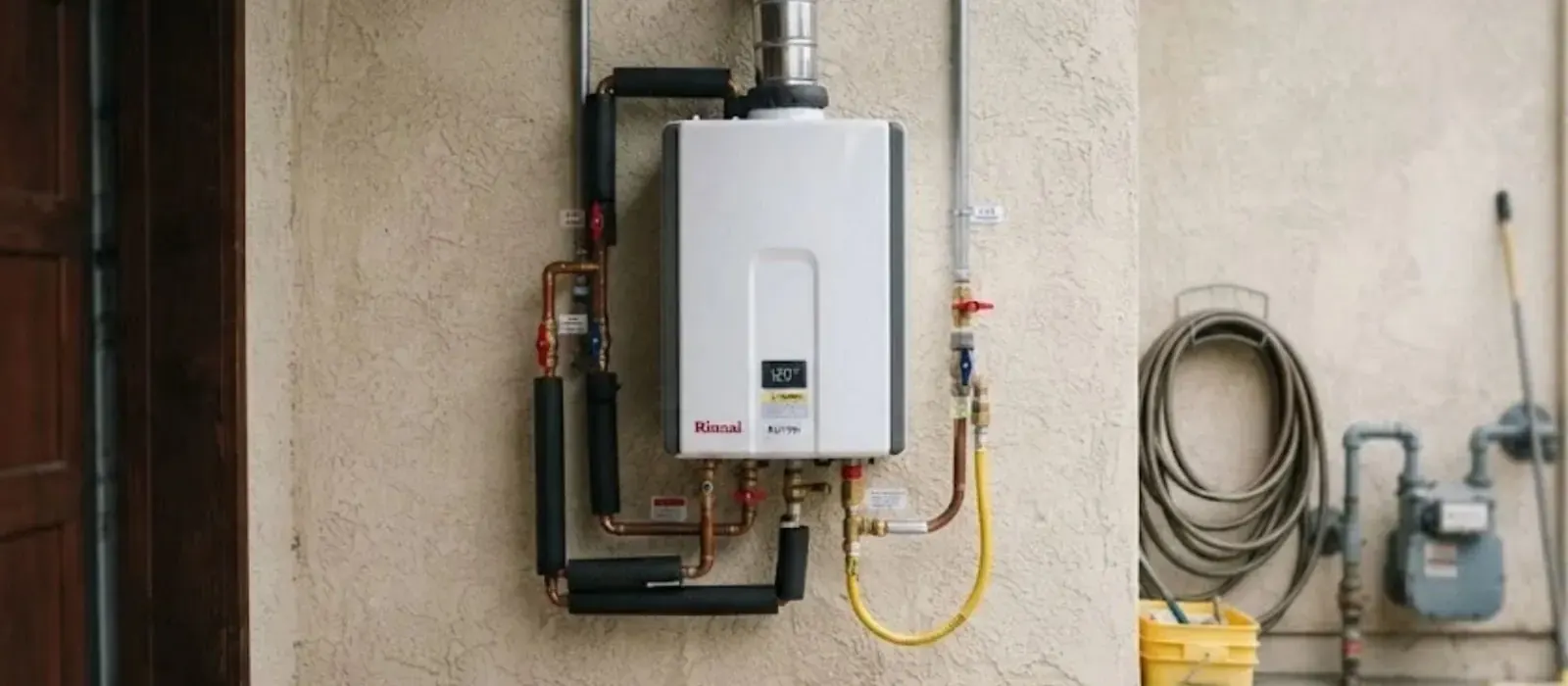
What happens in the seconds after you open the tap
Cold water enters the unit and passes a flow sensor. Once flow crosses the minimum the unit needs, the control board opens the gas valve, lights the burner and starts the fan. On an electric model, it energizes heating elements instead.
The hot gases or elements transfer heat into a heat exchanger, a set of metal passages the water runs through. Sensors read the outlet temperature and the board adjusts the flame to match the setpoint. Close the tap and the flow stops, the burner shuts off and the fan runs briefly to clear the exhaust.
The parts that matter when something goes wrong
Most tankless failures trace back to one of a handful of components.
Flow sensor
It tells the board water is moving. Low flow from a clogged screen or a nearly closed tap can keep the unit from firing at all.
Heat exchanger
This is where minerals in water bake onto metal as scale. Scale narrows the passages and the unit works harder for less hot water.
Burner, fan and vent
The fan pushes exhaust out through a vent that must be listed for the unit. A blocked or cracked vent shuts the heater down on purpose.
Condensate drain
A condensing model extracts extra heat from the exhaust, which produces acidic water that must drain somewhere. That path also has to be protected from freezing.
Tank versus tankless on the points that decide it
This compares what each design asks of the house, not which is better in general.
| Point | Storage tank | Tankless |
|---|---|---|
| How it makes hot water | Heats a full tank and holds it | Heats on demand as water flows |
| Typical life (DOE) | About 10 to 15 years | About 20 years |
| Gas supply | Usually the existing line | Often needs a 3/4 inch line |
| Venting | Standard flue or draft hood | Listed vent, sometimes sealed or PVC |
| Hard water impact | Sediment settles in the tank | Scale builds in the heat exchanger |
| Upfront cost | Lower | Higher |
| Running efficiency | Standby loss through the day | DOE says 8 to 34 percent more efficient |
Life and efficiency figures come from the Department of Energy. Your home may differ.
A second look at gas piping and venting before you buy keeps the upgrade from becoming a surprise project.
Clearfield water and the scale problem
Clearfield City buys most of its water from Weber Basin Water Conservancy District. The district reports that hardness can range from 10 to 18 grains per gallon, or about 171 to 308 parts per million. That is a district-wide range, not a Clearfield reading, because the city's own water quality report lists no hardness figure.
The Department of Energy says manufacturers may require a softener once hardness passes roughly 8 to 14 grains per gallon, and that flush schedules can run from twice a year to once every three years. The district's range sits above that line, so test your tap and read your unit's warranty terms before you buy.
Scale is why a water softener or filtration conversation belongs next to any tankless install here. Ask Clearfield City for its annual water quality report, and plan a descaling flush into your calendar.
Source: UTILITY, Weber Basin Water Conservancy District 2025 water quality report. FEDERAL, US Department of Energy tankless guide (Building America).
Not sure if your water and gas line suit a tankless unit? Call (801) 207-7520, the dispatch line is open 24/7.
Call (801) 207-7520How the flush works
A descaling flush circulates a mild acid solution, often vinegar or a manufacturer-approved cleaner, through the heat exchanger using a small pump and two hoses on service valves. The solution dissolves mineral deposits, then clean water rinses the lines. The point is to restore flow through the exchanger.
Units installed without service valves are harder to flush, so ask for valves at install. Follow the maker's instructions, because the wrong chemical can harm seals and passages.
Gas line, vent and winter in Clearfield
The Department of Energy notes that in most cases the gas line serving a tankless unit needs to be three quarters of an inch in diameter, with sizing set by the manufacturer and code. A long run to a garage corner may need upsizing, which is a real cost, not an afterthought.
Clearfield's frost line is 30 inches and the winter design temperature is 10 F, and the Ogden-area normals show about 38 days a year at or below 20 F. Ask your installer how the condensate line and any exterior vent termination are protected on those nights.
Who tankless suits, and who it does not
A tankless water heater tends to suit households that want endless hot water in a limited footprint and have, or can add, the gas capacity. It suits less well where two showers and a dishwasher run at once on a small unit, because each unit has a maximum flow it can heat.
ThermWise lists a rebate for ENERGY STAR certified gas tankless units, so confirm your model and the current amount. Homes in Syracuse and Clinton are a mix of eras and gas capacity, so the answer varies house by house.
Tankless questions answered
Is a tankless water heater worth it with Utah's hard water?
It can be, if you plan for scale. Weber Basin reports district hardness of 10 to 18 grains per gallon, which is above the 8 to 14 grain level where some manufacturers require softening.
Test your tap, check the warranty and budget for regular flushes.
Does a tankless heater really give endless hot water?
It gives continuous hot water as long as demand stays within the unit's flow rating. Run too many fixtures at once and the temperature drops.
Size the unit for your peak use, not your average day.
How often should a tankless heater be flushed?
The Department of Energy says frequency can vary from twice a year to once every three years, depending on the unit and the water. Follow the manufacturer.
Harder water pushes you toward the short end of that range.
Can a tankless unit use my existing gas line?
Sometimes, but often not. DOE notes the in-house gas line will in most cases need to be three quarters of an inch.
A plumber measures the run and fixtures before sizing anything.
How long does a tankless water heater last?
DOE puts tankless units at about 20 years, compared with 10 to 15 for storage heaters. Scale and neglected flushing are what cut that short.
Good water treatment and service valves protect that life.
What if the unit fails at night?
Shut off the gas or power at the unit, and if you smell gas, leave and call 911. A licensed plumber can diagnose the fault, whether scale, flow or venting.
The dispatch line is open 24/7.