What the job looks like from start to finish
The plumber finds the cleanout, usually a capped pipe in the basement, crawlspace, garage or outside near the foundation. If there is no cleanout, access may come from a toilet or roof vent, which takes longer and carries more risk.
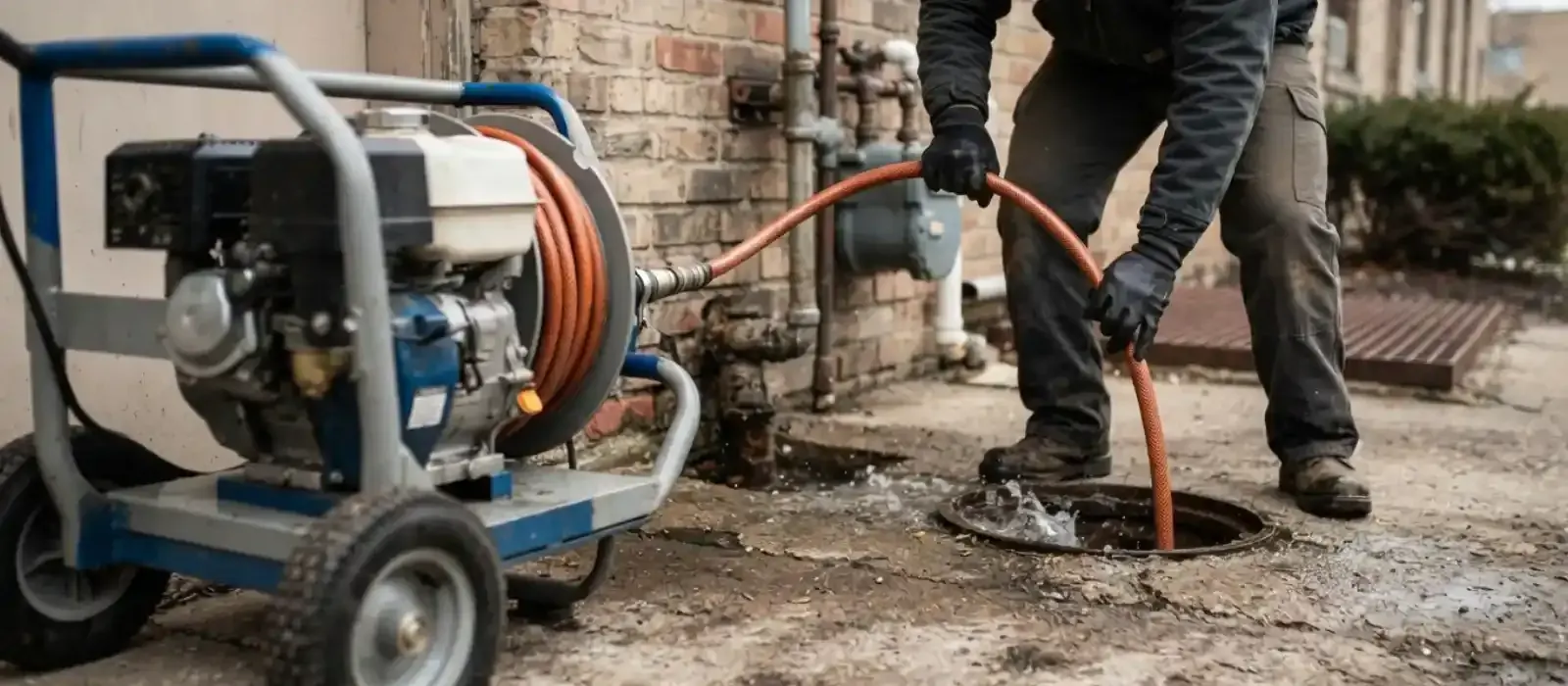
A camera usually goes in first so the plumber can see what is blocking the line and whether the pipe is sound enough to jet. Then the jetter hose goes in with a nozzle that fires jets backward. Those jets pull the hose forward and scour the wall as it is drawn back out.
Stage one: look before you blast
Jetting a cracked or collapsed pipe can wash soil into the line or widen a break. A quick camera pass tells the plumber whether to jet, to snake, or to stop and recommend repair.
Stage two: the cleaning pass
The hose is fed to the blockage, then pulled back while water runs. Grease, sludge, paper and loose scale are flushed down toward the main. A second pass may use a different nozzle for rougher buildup.
Stage three: confirm with a second camera look
A final camera run shows the clean pipe wall and any damage the blockage was hiding. Ask to see it. If something is wrong, you learn that on the same visit.
Jetting, snaking or neither: pick by what is in the pipe
A cable snake punches a hole through a blockage. Jetting cleans the whole pipe wall. Which one fits depends on what the clog is made of and how the pipe looks inside.
| What is in the line | Best first step | Why |
|---|---|---|
| Grease buildup and sludge | Hydro jetting | Water scours the wall, a cable only opens a channel |
| One soft clog, line otherwise clear | Cable snake | Quick, cheaper, enough for a single obstruction |
| Tree roots at a joint | Cutting head, then jetting | Roots regrow unless the wall is cleaned after cutting |
| Heavy scale in old iron pipe | Camera first, then judge | Scale can hide thin or cracked metal |
| Cracked, collapsed or offset pipe | Repair, not jetting | Water pressure can make a break worse |
These are general trade rules. A camera look settles which row you are in.
If you want the long version on why a snake fails to keep a grease line open, our hydro jetting service page covers it.
Who owns the line you are jetting in Clearfield
North Davis Sewer District serves Clearfield, along with Clinton, Layton, Roy, Sunset, Syracuse and West Point, through roughly 100 miles of collection lines. Its ordinance says building sewers, including the connection to the sewer, are owned and maintained by the connected property owner. In practice, the pipe from your house to the main is yours to clean and fix, while the main in the street is the district's.
That split matters on a backup day. If your whole street is slow and a neighbor has the same trouble, the problem may be the district main, and the district should hear about it. If only your house is backed up, the clog is usually on your side, and jetting your lateral is a reasonable first step.
The district also lists fats, oils and grease as the thing that plugs and backs up sewer lines more than anything else, and says wipes sold as flushable still belong in the trash. Both are exactly what jetting is good at removing. The district can also require a backwater valve on a property, paid for and maintained by the owner.
Source: SEWER DISTRICT, North Davis Sewer District ordinances and what-not-to-flush page.
Not sure whether to snake or jet? Call (801) 207-7520 and a licensed plumber will talk through your symptoms. The 24/7 line is open now.
Call (801) 207-7520Why you should not rent a jetter and do it yourself
Rental pressure washers with a small sewer hose exist, and they can clear a bathroom branch. They are not the same as a trade jetter. Smaller units lack the flow to carry debris out of a main, and a hose that kinks or a nozzle that sticks can injure you.
Utah licensing rules exempt only minor incidental fixture repair in a home, and work that changes waste piping is outside that. Cleaning a line is not the same as changing it, but if a camera shows a bad pipe, you need a licensed plumber for the repair. Do not open a cleanout with sewage standing behind it, because the backed-up water comes out fast.
What a jetting visit costs, in terms of factors
Jetting is priced by the situation, not the method. These are the factors that change the total.
- Access to the line
- A real cleanout is simple. Pulling a toilet or going through a roof vent costs more.
- Length and size of pipe
- A short lateral is quicker than a long run to a distant main.
- What is blocking it
- Light grease takes one pass. Packed roots or scale take several.
- Camera work
- Looking before and after adds time and also protects you from jetting a broken pipe.
- Time of day
- After-hours dispatch costs more than a scheduled visit, so ask how the price is built.
Insurance usually does not pay to clear a clog, because maintenance is excluded. Sewage damage from a sudden backup may be covered if you carry water backup coverage, so read your policy and call your insurer before cleanup.
For a clear price before work starts, call (801) 207-7520.
After the jet: keeping the line open
A clean pipe stays clean only if grease stops going into it. For a stubborn stoppage, a sewer drain and main cleaning visit is the next step. Wipe pans with a paper towel before washing, collect fat in a can, and keep wipes out of the toilet.
If grease is the cause and you live near Layton or Syracuse, the same advice applies. Our Layton plumbing page and Syracuse plumbing page cover local service, and the district's treatment plant, which receives what you flush, sits in Syracuse. Sluggish drains returning within months usually mean a repair, not another cleaning.
When jetting is not the answer
A cracked, offset or collapsed pipe needs repair. Jetting a line like that can wash soil in and make the damage bigger. A camera cannot see through a wall, so it will not find every problem, but it shows enough to avoid a wasteful pass.
We also do not treat septic systems. Septic tanks and drain fields follow different rules and need a septic pumper.
Hydro jetting questions from Clearfield homes
Who is responsible for the sewer line from my house to the street in Clearfield?
The property owner. North Davis Sewer District rules say building sewers, including the connection to the sewer, are owned and maintained by the connected owner. The district owns its collection mains. If you are unsure where your lateral ends, call the district before digging, and use 811 for utility marking.
How long does hydro jetting take?
A straightforward lateral is often done within a visit, including camera work. Heavy roots or scale add passes. We do not promise a duration before seeing the line, because the camera decides.
Can jetting damage my pipes?
On sound pipe, a trained plumber using the right nozzle is not a risk. On old, cracked or collapsed pipe it can be, which is why a camera look goes first. If the pipe is weak, the honest answer is repair.
Will jetting stop roots from coming back?
It clears roots and the grease they snag on, but roots grow back through any joint that stays open. Cleaning buys time. A durable fix means sealing or replacing the joint, which a camera helps you decide.
How often should a main line be jetted?
There is no set interval. A line with repeated grease problems may need it yearly, while a clean line may never need it. Fix the habit that fills the pipe, and use the camera to judge the schedule.
Is it safe to use drain chemicals before jetting?
Skip them. Standing caustic liquid in a pipe can burn the plumber and eat at old metal. Tell the plumber if you used any, so they handle the cleanout carefully.