What the water does inside the pipe
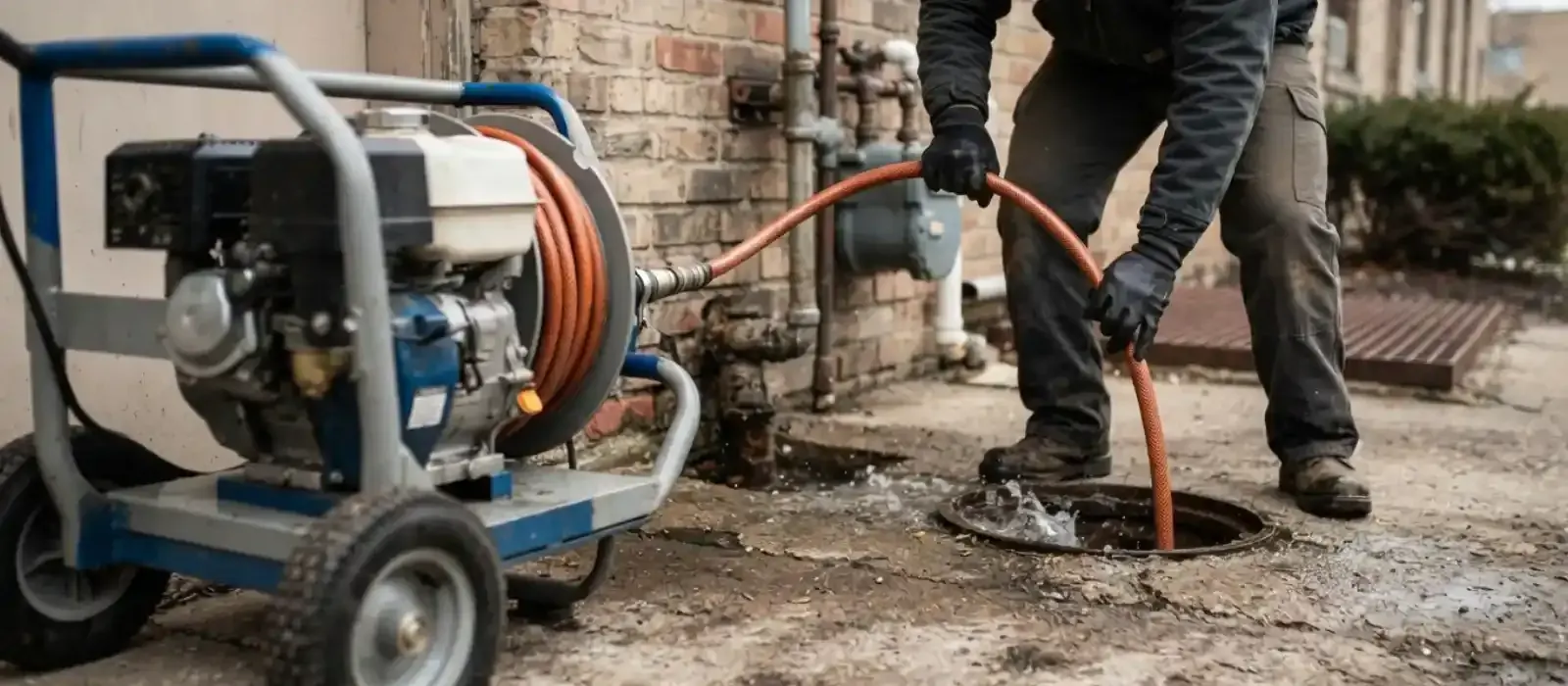
A jetting hose ends in a nozzle with several small ports. Most of them face backward, and the thrust of the water pulls the hose forward through the line, while a forward port breaks into the blockage ahead. The backward spray then washes the loosened debris down toward the cleanout where it can leave the pipe.
A cable punches a hole through a clog. Water cleans the circumference of the pipe, which is why a jetted line tends to stay clear longer than a cabled one. The job usually runs in four stages.
Camera first
A small camera goes down the line before any pressure is used. The plumber looks for cracks, offset joints, sagging sections and roots, because pressure in a broken pipe can wash out soil around it.
Forward pass
The nozzle works toward the blockage, breaking it up in short runs. Roots get cut back at the joint, and grease starts to let go of the wall.
Return pass
The plumber pulls the hose back slowly while the ports scour the pipe wall. Debris flows toward the opening, so nothing is parked deeper in the line.
Camera after
A second camera run confirms the wall is clean and shows anything the first look could not, such as a joint that was hidden by buildup.
Sewer backup right now: when jetting is the right call
Jetting is not the first move for every clog. A sink that drains slowly usually needs only a cable. A main line that backs up into the lowest tub or floor drain, especially for the second or third time, is where a water jet earns its place.
While you wait, stop flushing and laundry, and move belongings off the basement floor. Treat standing water as contaminated. The same dispatch line serves Syracuse and Layton. Nights and weekends are covered by the dispatch line, with same-day appointments booked when available and no arrival time promised.
Cable or water jet: how the plumber decides
Both tools have a place. The decision depends on the blockage, the pipe material and the pattern of repeat clogs.
| Blockage | Cable | Water jet | Plumber's call |
|---|---|---|---|
| Hair and soap in a tub branch | Usually enough | More than needed | Cable first |
| Packed grease in a kitchen or main line | Opens a channel | Strips the wall | Jet if it returns |
| Fine roots at pipe joints | Cuts the strands | Clears the joint area | Jet, then watch the line |
| Scale in old cast iron | Barely touches it | Removes loose scale | Camera first, jet with care |
| Solid object stuck in the line | Can retrieve it | May push it deeper | Cable or retrieval tool |
| Cracked or collapsed pipe | Stops at the break | Can worsen the damage | Repair, not jetting |
Blockage type and pipe condition set the tool. Pressure is never turned up just to save a second visit.
Whose pipe gets jetted: the Clearfield property line
North Davis Sewer District owns the collection mains under the street. Under its ordinances, the building sewer, including the connection to the main, belongs to the property owner, who pays to maintain and repair it. A jetting job from your cleanout therefore covers your own line, and a blockage in a district main is the district's to clear.
That split matters in Clearfield because many lines are not young. About 2,123 of the city's 12,042 housing units were built in the 1970s and roughly 4,732 before 1980, so plenty of laterals have had decades for roots and grease to settle in. The plumber's camera shows which side of the line the blockage is on, and the district's number is on its own site if it points to the main.
Source: North Davis Sewer District ordinances adopted October 2025 and U.S. Census Bureau American Community Survey 2020 to 2024 housing tables.
What builds up in a sewer line and what a jet removes
Different materials call for different handling. The district's guidance and ordinary trade experience point to the same short list.
- Grease and cooking fat: coats the wall and traps solids. The district names it as the top cause of plugged and backed up sewer lines.
- Wipes, including those sold as flushable: they knit together into a rope that cables slide through. A jet can break the rope apart.
- Tree roots: fine roots find small gaps at joints and grow into a mat. Jetting cuts them back, though the joint itself still needs a look.
- Mineral scale: a rough crust inside older metal pipe that snags paper and waste. Light scale comes off, heavy scale may need repair.
A jet clears the line but does not change what you send down it. If wipes and grease keep going into the drain, the same buildup returns, and the sewer line cleaning page explains the habits that matter.
Backup at midnight or a line that clogs every few weeks? Call (801) 207-7520. The line is open 24/7 for after-hours calls, with same-day appointments when available.
Call (801) 207-7520Where hydro jetting is the wrong choice
Water pressure inside a weak pipe is a risk. A cracked clay line, a collapsed section, a joint that has dropped, or fiber conduit that has softened can all be made worse by a jet. That is why the camera goes first, and why the plumber may decline to jet and suggest sewer line repair instead.
Jetting also does not suit small indoor fixture drains, where a cable or hand auger does the job with less risk of splashing. We do not treat septic systems. If the camera finds roots that have broken a joint, cleaning will buy time but not fix the break.
What changes the price of a jetting visit
Jetting is priced by the job, not by a flat rate, and the plumber tells you the price before work starts. These are the factors behind it.
- Length and size of the line
- A short lateral to the street takes less time than a long run through a larger pipe, and each added section adds passes.
- Type of buildup
- Light grease washes off quickly. Dense roots, heavy scale and wipe ropes need slower, repeated work.
- Access point
- A cleanout at the foundation or yard makes it simple. If the plumber must remove a toilet or dig out a buried cleanout, the time rises.
- Camera work
- Looking before and after is part of safe jetting, and the findings may lead to a repair quote as a separate item.
- Whether the problem is repeat
- A first backup may need one pass. A line that clogs every few months may need a plan, not just one more clearing.
Insurance rarely pays to clean a line that clogged from ordinary use. Sudden and accidental damage inside the home may be covered if your policy includes water backup, so check the policy before you assume either way.
Describe what you see when you call (801) 207-7520, and the plumber will lay out the options and the price before starting.
Hydro jetting questions from Clearfield homeowners
Do you handle hydro jetting emergencies at night or on weekends in Clearfield?
Yes. The dispatch line at (801) 207-7520 is open 24/7, including nights and weekends. A licensed plumber is booked for the same day when an appointment is available, though no arrival time is promised. While you wait, stop flushing and running water and keep everyone out of any standing sewage.
Can hydro jetting damage old pipes?
It can if the pipe is already weak. That is why a camera goes through the line first. If the pipe is cracked, collapsed or offset, the plumber will tell you jetting is a poor idea and explain the repair options. A sound old line can usually be jetted with care.
Is jetting better than a cable for tree roots?
For fine roots it often is, because the water cuts and flushes them out instead of leaving a rough stub. Heavy roots that have split a joint need a repair. Jetting clears the roots but does not close the opening they came through.
Will hydro jetting stop my sewer from backing up again?
It removes what is in the pipe today and leaves the wall clean. Whether it stays clear depends on what goes into the line and on the pipe condition. Grease, wipes and open joints bring the problem back. The plumber will tell you what the camera showed.
Who pays to clear a clog between the house and the street?
Under North Davis Sewer District ordinances, the property owner maintains the building sewer, including the connection to the main. The district handles its own mains. If neighbors are backing up at the same time, the main may be blocked. Call the district first.
Can you jet a grease-heavy kitchen line in a restaurant or business?
A licensed plumber can jet commercial drain lines, and grease buildup is one of the most common reasons to do it. Grease traps and interceptors are separate equipment with their own upkeep, covered on our commercial plumbing page. Call (801) 207-7520 to describe the building.