
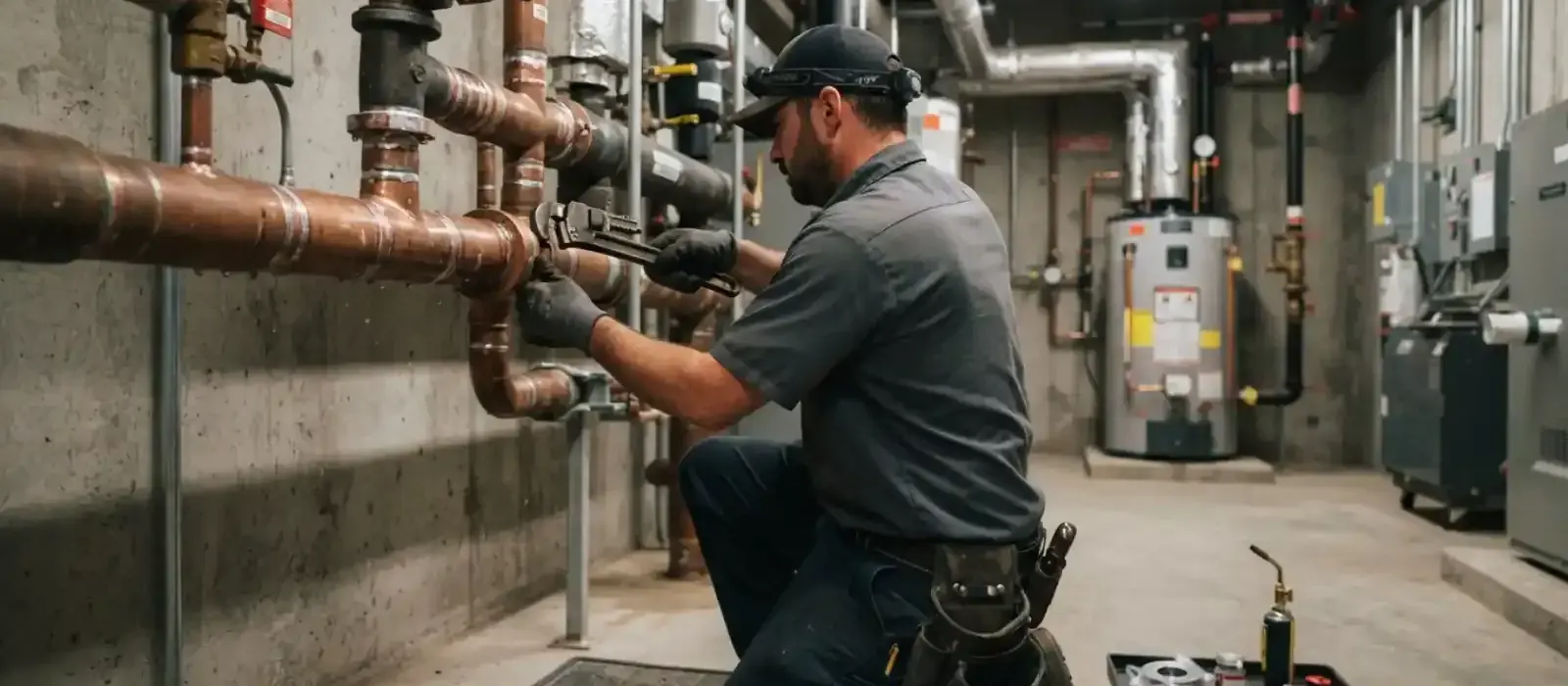
Commercial plumbing emergency: flooding, backups and burst lines
A commercial emergency is any failure that stops the business or damages the building. Think of water across a sales floor, overflowing restrooms, a kitchen with no working drain, or a line that split in an unheated warehouse bay.
While you wait, close the main shutoff, often near the water meter, in a utility room, or at the base of a riser. Tenants in a multi-suite building should find the suite valve and ask the property manager about the building main. Stop flushing, shut off dishwashers and ice machines, and keep everyone off wet floors near panels and outlets.
If you smell gas, do not hunt for the source. Leave the building and call 911 or the gas utility from outside.
Freeport Center buildings and the booster pump zone
The Freeport Center began as a Navy supply depot built between June 1942 and April 1943, and the Navy phased it out by 1962. It is now a manufacturing, warehousing and distribution hub inside Clearfield. Buildings that old have been split, extended and re-tenanted, so the drawings on file may not match what runs under the slab. Ask for a line locate and a drain camera pass before anyone cuts concrete.
Clearfield's water system is mostly gravity fed with pressure-regulating valves, and one booster pump station serves the Freeport Center and the area south of Antelope Drive. If pipes bang or pressure swings through the day, a gauge on a hose bib shows static pressure. That separates a worn pressure-reducing valve inside the building from a supply-side question for the city.
Source: Clearfield City Public Works water department page and the Utah History Encyclopedia entry for Clearfield (Utah Division of State History).
Commercial leak detection: what it finds and what it cannot
Most business leaks announce themselves quietly. The water bill climbs while operations stay the same, ceiling tiles stain below a restroom, carpet stays damp along one wall, or a slab feels warm in one patch. A meter dial that creeps with every fixture closed confirms water is leaking somewhere on the property.
The plumber then closes zone valves one branch at a time to see which closure stops the movement. The isolated line gets a pressure test with a gauge, and acoustic equipment listens along the pipe and slab. A thermal camera shows warm hot-line leaks and damp materials, and a drain camera checks waste lines.
The limits are real. A camera cannot see inside a closed wall, and no honest plumber can quote a leak before looking. Opening a floor in a leased space also needs the owner's permission.
Which fix fits which commercial problem
Use this as a rough map before the call. The plumber confirms the cause on site.
| Situation | First check | Usual repair | When it makes sense |
|---|---|---|---|
| One restroom fixture stopped | Plunge, then the trap arm | Cable the fixture line | Only that fixture is slow |
| Several fixtures back up together | Floor drain and cleanout | Clear the branch or main | A shared line is blocked |
| Kitchen drains slow, grease smell | Grease trap lid | Clean trap, jet the line | Grease is the known load |
| Meter runs, nothing open | Zone valves and slab | Isolate, test, repair line | Bill rose without a cause |
| Pooling at a loading dock | Catch basin and roof drain tie | Clear or repair storm line | Rain is the trigger |
Named rules that apply to commercial lines
The Utah Division of Drinking Water confirms that Utah adopted the International Plumbing Code with state amendments to chapters 3, 6 and 13, and backflow prevention is part of that framework. Clearfield City's 2026 design criteria list the 2024 International Plumbing Code as the adopted plumbing code, effective July 1, 2026.
For a business, the practical step is to ask which of your assemblies need testing and when. Keep the test records where a landlord or inspector can find them.
After-hours checklist for a business with a plumbing failure
- Make sure someone on staff knows where the main shutoff is, and close it for any active leak.
- Tell the landlord or property manager right away if you lease the space, since the building may have its own shutoffs.
- Keep people out of any area where water has reached outlets, panels or equipment.
- Lift stock and paper records off the floor if it can be done without wading through water.
- Write down which fixtures, floor drains or lines are affected before you call, so dispatch can send the right tools.
- Do not pour chemical products into floor drains. They can burn the plumber who opens the line.
Standing water, a backed-up floor drain, or a dead heater in the middle of business hours? Call the dispatch line and describe the building.
Call (801) 207-7520Grease traps, floor drains and the sewer district
North Davis Sewer District serves Clearfield, and it says fats, oils and grease plug and back up sewer lines more than anything else. Disposals and hot soapy water do not stop grease. They only move it down the line.
For a kitchen, the grease trap is the first defense. A full trap lets grease past the baffle into the building drain, where it hardens in the lateral. Hydro jetting removes what has already coated the pipe walls. Pumping trap waste is often a separate hauler's job, and we will say so on the phone.
Backflow testing for assemblies Clearfield tracks
Clearfield City states that backflow prevention assemblies must be tested by a certified tester at installation, after a major repair, and at least once a year. Commercial sites carry more of them than houses: irrigation assemblies on landscaped lots, boiler feed lines, and carbonated drink machines.
A failed test usually means a worn check or relief valve, fixed with a rebuild kit or a new assembly and a retest. Ask on the call whether the plumber we send can test your assembly type. If not, the state keeps a public tester list and we will point you to it.
Storm drains, catch basins and loading docks
Clearfield's storm water division says only storm water belongs in a storm drain, and its list of unwanted discharges includes oil, grease, paint, fertilizer and chlorinated pool water. A mop sink dumped into a parking lot basin counts, so washdown water belongs on the sanitary side.
Spring brings the most rain, with Ogden-area normals of 1.97 inches in April and 2.17 in May. That is when plugged roof drains and silted basins show up as pooling at dock doors. The plumber clears the line and checks the tie-in.
After hours, weekends and cold snaps
Ogden-area normals show about 121 nights a year at or below 32 degrees, and about 38 at or below 20. Open dock doors, unheated mechanical rooms and exterior hose bibs are where lines split first. A closed building over a long weekend can run for two days before anyone sees the water.
That is why the 24/7 line takes commercial calls at any hour, and why same-day appointments are offered when available. For a split line, see our burst pipe repair page. Businesses in Layton and Syracuse reach the same dispatch.
What changes the cost of a commercial plumbing visit
We cannot price a job we have not seen. These five factors drive the final figure.
- Scope of the system
- One fixture, a shared stack and a slab line are three different jobs, even when the symptom looks the same.
- Access
- Ceilings, mechanical rooms and finished walls change diagnosis and repair time.
- Time of day
- Work after closing or at night follows different scheduling than a weekday visit.
- Parts and equipment
- Commercial flush valves, heaters and backflow assemblies cost more than household versions.
- Permits and coordination
- A heater or line replacement may need a permit, and a landlord's approval can add steps.
Commercial property policies often respond to sudden, accidental water damage and exclude wear, slow leaks and neglected maintenance. Business interruption cover is usually a separate part of the policy, so check yours.
You get a clear price before work starts. Call (801) 207-7520 and describe the building and the problem.
When this is not a plumbing job
A roof leak needs a roofer, even if the stain lands above a restroom. Fire sprinkler systems usually go to a sprinkler contractor, and rooftop condensate trouble can belong to an HVAC technician.
The connected owner maintains the building sewer up to the connection, while North Davis Sewer District owns the main. If a backup involves the main, the district takes that call, and a camera pass shows which side the blockage sits on. See sewer line cleaning for the owner's side.
Questions from Clearfield business owners
Do you handle commercial plumbing emergencies at night or on weekends in Clearfield?
Yes. The dispatch line is open 24/7, and we send a licensed plumber for burst lines, overflowing restrooms and sewage backups at any hour. We do not promise an arrival time, because it depends on the queue and the roads. Close the main shutoff, stay clear of wet electrical areas, and call (801) 207-7520.
Who pays when a pipe fails in a leased space?
Your lease decides, and we cannot read it for you. Generally the owner covers building systems and the tenant covers their own fixtures and equipment. Photograph the damage, tell the property manager early, and keep the written repair notes for your insurer.
How do you find a commercial leak without opening walls?
The plumber starts with a meter test, then closes zone valves to narrow the area. Pressure testing, acoustic listening and a thermal camera pin down the spot. Some leaks still need a small opening.
Who handles a sewer backup, my business or North Davis Sewer District?
The connected owner maintains the building sewer, including its connection, and the district owns its mains. If several buildings back up at once, call the district. If only yours does, a camera pass from the cleanout shows where the blockage sits.
Do you test backflow assemblies?
Clearfield requires testing by a certified tester on installation, after major repair, and at least annually. Ask when you call whether the plumber we dispatch can test your assembly. If not, the state publishes a tester list and we will say so plainly.
Do commercial repairs in Clearfield need a permit?
The city says most repairs or alterations need a permit, and lists water heater replacements and new or replacement plumbing lines. Fixture swaps do not. Permit rules vary by scope and by tenant space, so ask the Clearfield City building department before work begins.