
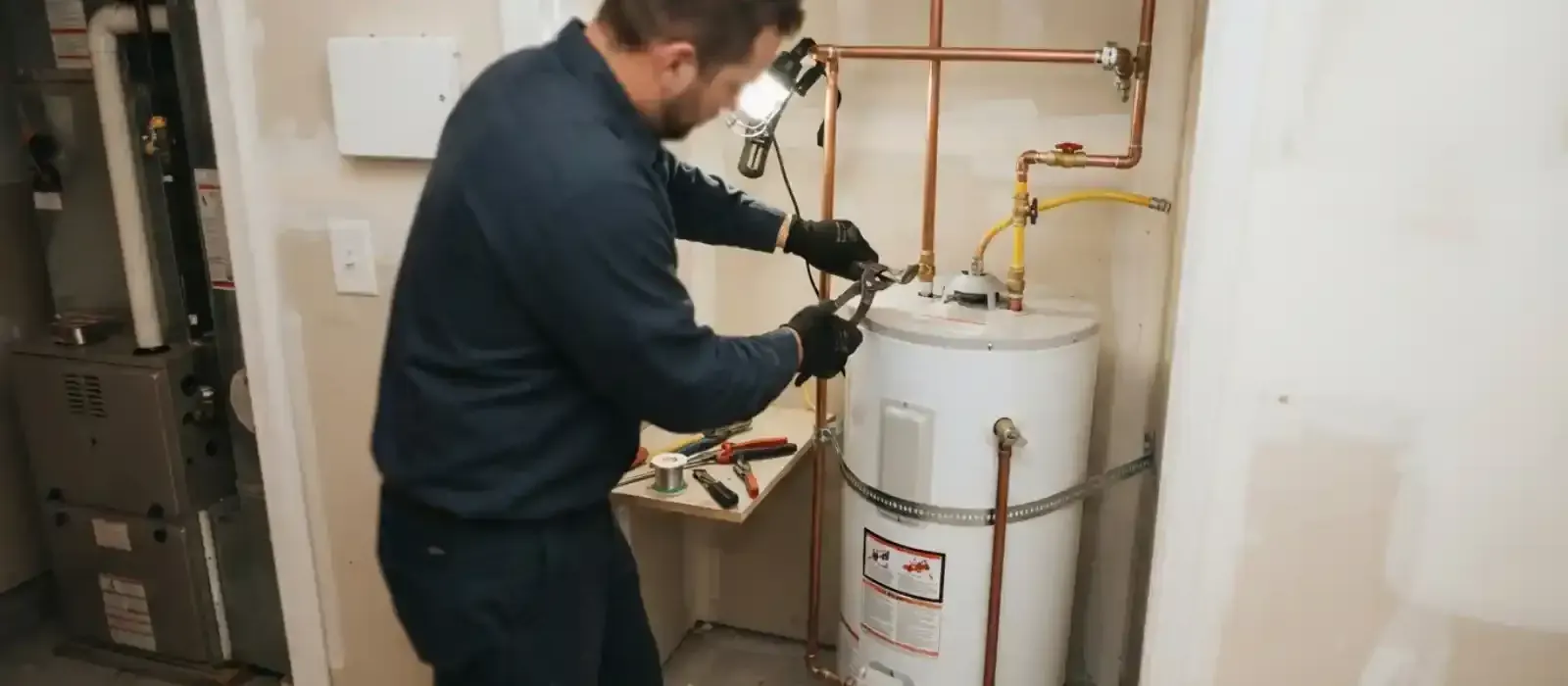
Can you do this yourself in Utah?
Utah law exempts minor repairs to a fixture or appliance in a home, but the exemption stops short of two things that a water heater swap involves. It does not cover work that changes culinary water piping, and it does not cover a gas appliance or combustion system. A gas heater swap does both.
An electric unit still touches the water piping, so check with the Utah Division of Professional Licensing before you decide to go it alone. If you do hold the permit and do the work, the rest of this page is the order a careful job follows.
What Clearfield requires for a water heater swap
Clearfield City's list of work that needs a building permit names water heater installations and replacements outright. The same list says replacing plumbing fixtures needs no permit, but new or replacement plumbing lines do, and gas lines are on it too.
The city's design criteria for permits now list the 2024 International Plumbing Code, effective July 1, 2026. Ask the building department which edition applies to your permit date before you buy parts, because venting and relief discharge details are where editions differ.
Clearfield is also in seismic design category D or D1. Utah's earthquake program calls strapping down your water heater one of the best non-structural measures you can take, because a toppled unit can cause fires, flooding and carbon monoxide build-up. Plan on straps as part of the job, not an extra.
Source: CITY, Clearfield City building permit guidance and 2026 permit design criteria. STATE, Utah Code 58-55-305 and the Utah earthquake program.
Choose the replacement before you drain anything
Match the fuel first. A gas heater needs a gas line, a flue that terminates outdoors and combustion air, while an electric unit needs a dedicated circuit sized to its elements. Changing fuel type is a bigger job than a like for like swap.
Then match the footprint. Measure the closet or garage corner for height, diameter and clearance to the wall, and check where the old relief valve pipe ran. Homes built before 1980 are about 39 percent of Clearfield's housing, and those closets often hold a tank that is shorter and wider than today's models.
What should be on the floor before you start
Half of a bad swap is a missing part found with the water already drained. Lay these out first.
- The new heater, matched on fuel, capacity and venting type
- Two flexible water connectors and a new gas flex connector for a gas unit
- Thread sealant rated for gas on the gas joint and plumber tape on water threads
- A new relief valve discharge pipe that runs to a safe spot, never capped or reduced
- A seismic strap kit rated for the tank size
- A drain pan if the unit sits above finished floor, and a garden hose for draining
- An expansion tank if the home has a closed system with a check valve or pressure reducer
Reusing the old gas flex or water connectors is the shortcut that fails first.
The swap in order, one step at a time
Work through these in sequence. Skipping ahead is how tanks get fired dry and valves get cross-threaded.
1. Shut off fuel and power
For gas, turn the control to off and close the gas valve on the line. For electric, switch off the breaker and confirm with a tester that the leads are dead. Do both before you touch a single wrench.
2. Close the cold supply and open a hot tap
Shut the cold valve at the top of the tank, then open a hot faucet upstairs so air can enter. Attach a hose to the drain valve and run it to a floor drain or outdoors.
3. Disconnect and lift out the old unit
Break the water unions, the gas union and the vent connection, and cap the gas line. A full 40 gallon tank that still holds water is heavy, so drain completely and bring a second person.
4. Set, level and strap the new tank
Place the heater, check clearances and level it with shims if the floor slopes. Fasten the straps to wall studs, not drywall, at the upper and lower thirds of the tank.
5. Reconnect water, relief valve, gas and vent
Connect the cold and hot lines, thread in the relief valve if it is not factory fitted, and run the discharge pipe downhill. Reconnect the gas with a fresh flex and test every joint with leak solution. Reattach the flue so it rises continuously with no sags.
6. Fill the tank before you fire it
Open the cold valve with the hot tap still running until water flows steadily and air stops sputtering. Only then restore power or relight the pilot. Firing an empty tank burns out elements or damages the tank bottom within minutes.
7. Test, then inspect
Watch the burner and the flue draft, and check every joint for weeping. Then set the thermostat and book the city inspection.
Would rather watch a licensed plumber do the swap? Call (801) 207-7520, the dispatch line is open 24/7.
Call (801) 207-7520Where DIY should stop
Stop the moment you smell gas. Leave the building and call 911 or your gas utility from outside. Do not flip switches, light anything or go back for the unit.
Stop too if the flue is cracked, corroded or sagging, if the old unit left soot marks around the draft hood, or if you cannot get the gas joints to hold a leak test. Enbridge Gas advises yearly inspection of gas appliances by a qualified contractor, and each fault it lists is one a first-timer will miss.
Freeze nights and where the heater lives
Ogden-area NOAA normals show about 121 days a year with a low at or below 32 F, and roughly 38 days at or below 20 F. A heater in an unheated garage or attic closet sees those nights directly. Insulate exposed supply lines before winter.
The same swap is done across the area, from Layton to Sunset, and the permit and strapping points above travel with you.
Mistakes that bring the plumber back
Capping or shrinking the relief valve discharge is the worst one, because that pipe is the safety path if the tank overheats. Close behind are skipping the expansion tank on a closed system and leaving the thermostat too high. DOE suggests 120 F as a sensible setting for most homes.
If your project grows into pipe changes or a fuel switch, the team that handles water heater installation can scope it before you commit to parts.
Questions people ask before a swap
Do I need a permit to replace my water heater in Clearfield, Utah?
Yes, as far as the city's published list goes. Clearfield City names water heater installations and replacements as work that needs a building permit, and says new or replacement plumbing lines and gas lines need one too.
Rules and fees change, so ask the Clearfield City building department first.
Can I replace a gas water heater myself in Utah?
Utah's minor-repair exemption does not cover work on a gas appliance or combustion system, or work that modifies culinary water piping. That puts a gas heater swap outside the exemption for most homeowners.
A licensed plumber is the safe statement. To confirm your situation, the Utah Division of Professional Licensing can answer licensing questions directly.
How long should a water heater last?
The Department of Energy puts storage tank heaters at about 10 to 15 years and tankless units at about 20. Those are averages, not promises.
A tank that leaks from the base, rumbles from sediment or needs frequent relighting is usually past repair. Water pooling under the shell means the tank has failed.
Do I really have to strap a water heater?
Clearfield sits in seismic design category D or D1, and Utah's earthquake program calls strapping one of the best non-structural steps you can take. A tipped heater can break its gas line and its water connections at once.
Straps go through the studs, not the drywall. Ask for flexible gas connectors too, since FEMA also advises bracing and flexible gas lines.
Should I go tankless when my tank fails?
It depends on gas line size, venting, your hot water habits and the water itself. Tankless units last longer and cost more upfront, and they often need a larger gas line and a different vent.
Weigh it before the old tank comes out, through a water heater replacement visit.
What do I do if I smell gas near my water heater?
Leave the building right away and call 911 or the gas utility from outside. Do not operate switches, phones or lighters inside.
Once the area is cleared and the source is found, a licensed plumber can check the flex line, the valve and the burner assembly. Never relight a leaking pilot.