
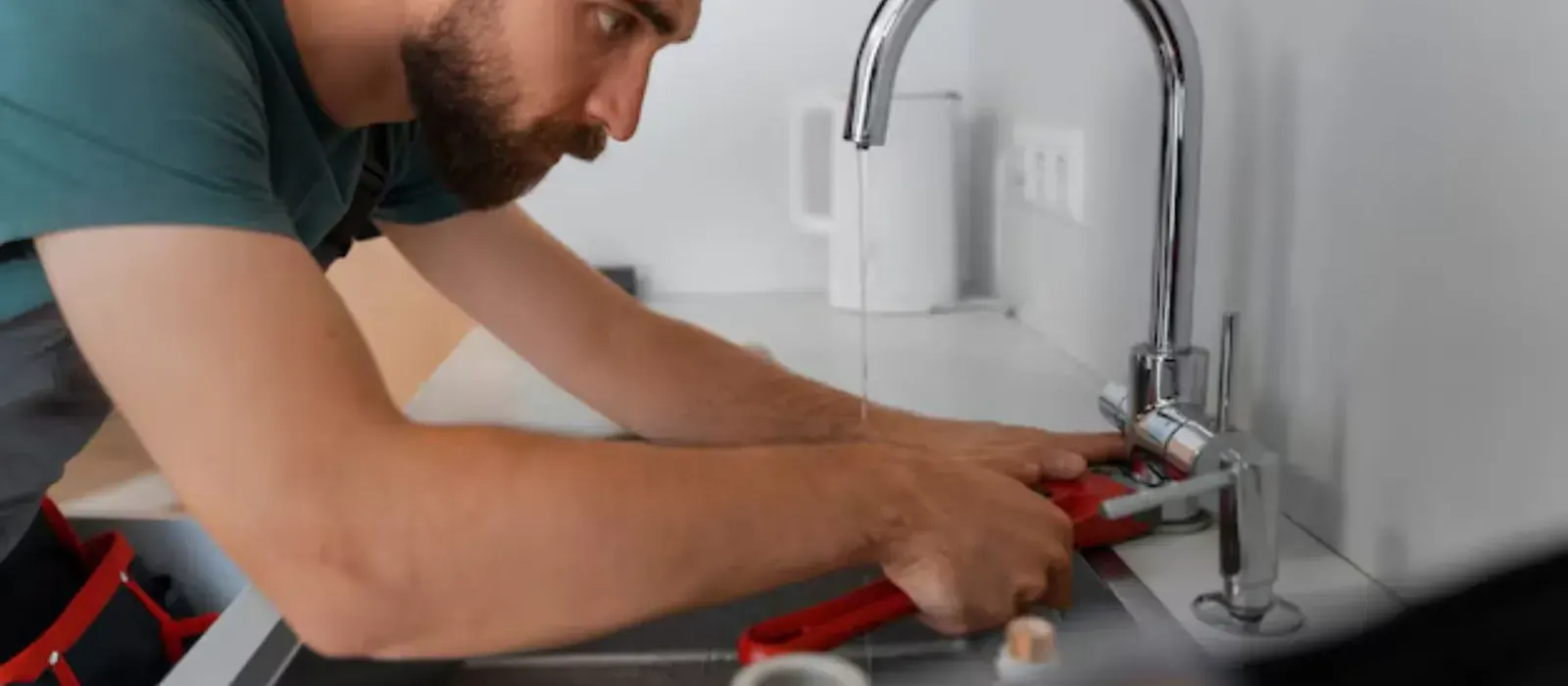
Where the drip comes from tells you what is worn
A drip from the spout, even when the handle is fully closed, points to the internal seal. In a compression faucet that seal is a rubber washer against a seat. In a cartridge or ceramic disc faucet it is the cartridge itself.
Water seeping around the base of the handle means a worn O-ring or packing nut. Water under the sink, pooling in the cabinet, is a different story and usually involves a supply line or the shutoff valve.
Identify the faucet before you buy parts
Parts are not interchangeable between faucet types. Look at how the handles move and check the spout for a brand name.
Two handles that turn many times
This is usually a compression faucet. Each handle tightens a rubber washer onto a seat. Worn washers cause a steady drip, and a pitted seat eats a new washer within weeks.
One lever that lifts and swings
This is a cartridge, ball, or ceramic disc design. The cartridge is a sealed unit, so you replace the whole thing, and it must match the brand and model.
Two handles with a quarter turn feel
Ceramic disc cartridges stop quickly and cleanly. When one leaks, grit or mineral scale in the cartridge is a common culprit, so cleaning can work before replacement.
Bring the old cartridge to the store to match it.
What to have on the counter before you start
Set everything out first.
- An adjustable wrench and a flat and Phillips screwdriver
- A hex key set, since many handles hide a small set screw
- A rag or towel to cover the drain opening so parts cannot fall in
- Plumber's grease and a replacement for the exact part
- A small bowl to keep screws in order
- A flashlight for the cabinet and the shutoff valves
Stop the work if a shutoff valve will not close. Forcing a stuck valve can break it, and that turns a drip into a flood.
The repair, step by step
Close both angle stops under the sink by turning them clockwise. Open the faucet to drain the line and confirm the water is off. Plug the drain with the rag before you take anything apart.
Pry off the decorative cap, remove the handle screw, and lift off the handle. Unscrew the packing nut or retaining clip and pull the cartridge or stem straight up.
Look at the seat inside the faucet body. A rough or pitted seat can be smoothed with a seat dresser or replaced, otherwise the new washer wears out fast. Coat the O-rings with plumber's grease, reassemble in reverse order, and turn the water back on slowly.
Watch the spout and base for several minutes. A faucet that still weeps usually has the wrong part or a damaged seat.
Faucet still dripping after a repair? Call (801) 207-7520. Licensed plumbers are on the 24/7 dispatch line and quote the price before work starts.
Call (801) 207-7520Why a small drip matters on a Clearfield water bill
The EPA's WaterSense program says a faucet that drips once per second can waste more than 3,000 gallons a year. It also says nearly 9 percent of homes have leaks that waste 50 gallons or more per day. Those are national figures, not Clearfield measurements, but they show why a small drip is worth fixing.
Clearfield City bills on tiered conservation rates. The city's water page says households using 0 to 10,000 gallons per cycle see only the small annual January increase, so a leak that pushes you into a higher tier costs more than the water itself. The page gives no dollar rates in text, so check your bill for your tier.
WaterSense suggests a simple test. Read the water meter, avoid using water for two hours, and read it again. If the number moved, something is leaking.
On permits, Clearfield's building permit guidance says replacing plumbing fixtures needs no permit, while new or replacement plumbing lines do. Swapping a faucet is fixture work, but moving a supply line is not.
Source: FEDERAL EPA WaterSense Fix a Leak Week, CITY Clearfield City Public Works water page and building permit guidance.
Repair the faucet or replace it
Many bathroom faucets cost less to replace than to rebuild.
| Situation | Repair | Replace |
|---|---|---|
| Steady drip from the spout | Fits if a washer, cartridge, or seat is the fault | Fits if parts are discontinued |
| Corroded or pitted body | Rarely worth it | Usually the better route |
| Wobbling handle or base | Tighten the nut or replace the O-ring | Fits if the mounting is cracked |
| Faucet over many years old | Possible if parts exist | Often saves repeat visits |
| Leak below the sink | Check supply lines and valves first | Replace if the faucet shank leaks |
When the leak is not really the faucet
Water under the cabinet usually comes from a braided supply line, a stop valve, or the drain trap. Tightening a compression nut a quarter turn can stop a weep. A stop valve that drips from its stem or will not shut firmly should be replaced, and that work falls under water line repair.
Low pressure at one faucet is often a clogged aerator. Unscrew it, soak it in vinegar, and rinse. If every fixture has weak pressure, the problem is upstream of the faucet and a plumber should look at the supply side.
Where DIY should stop
Utah licensing law exempts minor incidental repair of a fixture in a residential building, as long as the work does not modify culinary water, soil, waste, or vent piping. A cartridge or washer swap fits that, and a plumber handles the rest through faucet repair. Replacing a corroded valve, moving a supply line, or re-piping under the sink does not.
Stop and call a licensed plumber if the shutoff valve will not close, the pipe is cracked, or the leak keeps coming back after a clean repair. You can also call us from Layton or Clinton to get a plumber to the house.
What changes the cost of a faucet repair
A drip fix can be a small job or a bigger one, depending on what the plumber finds.
- Faucet type and brand
- Common cartridges are easy to source. Specialty or imported fixtures can need ordered parts.
- Condition of the valves
- If the stop valves are stuck or leaking, they get replaced before the faucet work can safely start.
- Repair or replace
- A new faucet costs more than a washer, but it also ends repeat repairs on a worn body.
- Access under the sink
- A crowded vanity with a pop-up drain assembly takes longer than an open pedestal sink.
- Water damage
- A cabinet floor that has been wet for weeks may need drying or replacement.
Homeowners insurance usually covers sudden and accidental water damage and rarely covers a worn faucet itself. A slow drip that rots a vanity is often treated as wear, so read your policy.
Call (801) 207-7520 and we will explain the price before work starts.
Faucet repair questions from Clearfield homes
How much water does a dripping faucet waste in Utah?
Here is the best available figure. The EPA says a faucet dripping once per second can waste more than 3,000 gallons per year. That is a national estimate, not a Utah or Clearfield measurement.
Check your own meter using the two hour test to see what your home loses.
Do I need a permit to replace a bathroom faucet in Clearfield?
Clearfield's permit guidance says replacing plumbing fixtures needs no permit. New or replacement plumbing lines do. If your project moves supply lines, ask the Clearfield City building department.
Permit rules vary by project.
Why does my faucet drip right after I replaced the cartridge?
Check the seat first. A pitted seat can chew through a new washer. A cartridge that is not fully seated, or the wrong model, will also weep.
Compare the part against the old one.
Should I fix or replace a leaky faucet?
If the fixture is in good shape and parts are available, repair is reasonable. If the body is corroded or the faucet is very old, replacement avoids repeat repairs.
A plumber can tell you which applies.
Why is there water under the sink but the faucet looks dry?
Look at the supply lines, the stop valves, and the drain trap. A weeping compression nut is a common cause. Dry the area and watch it with a paper towel.
A cracked line needs replacing.
Can a leaky faucet raise my water bill?
Yes, if it runs long enough. Clearfield uses tiered conservation rates, so extra use can push a household into a higher tier. The city page gives no dollar figures in text.
Fixing a drip is one of the cheapest ways to trim usage.