
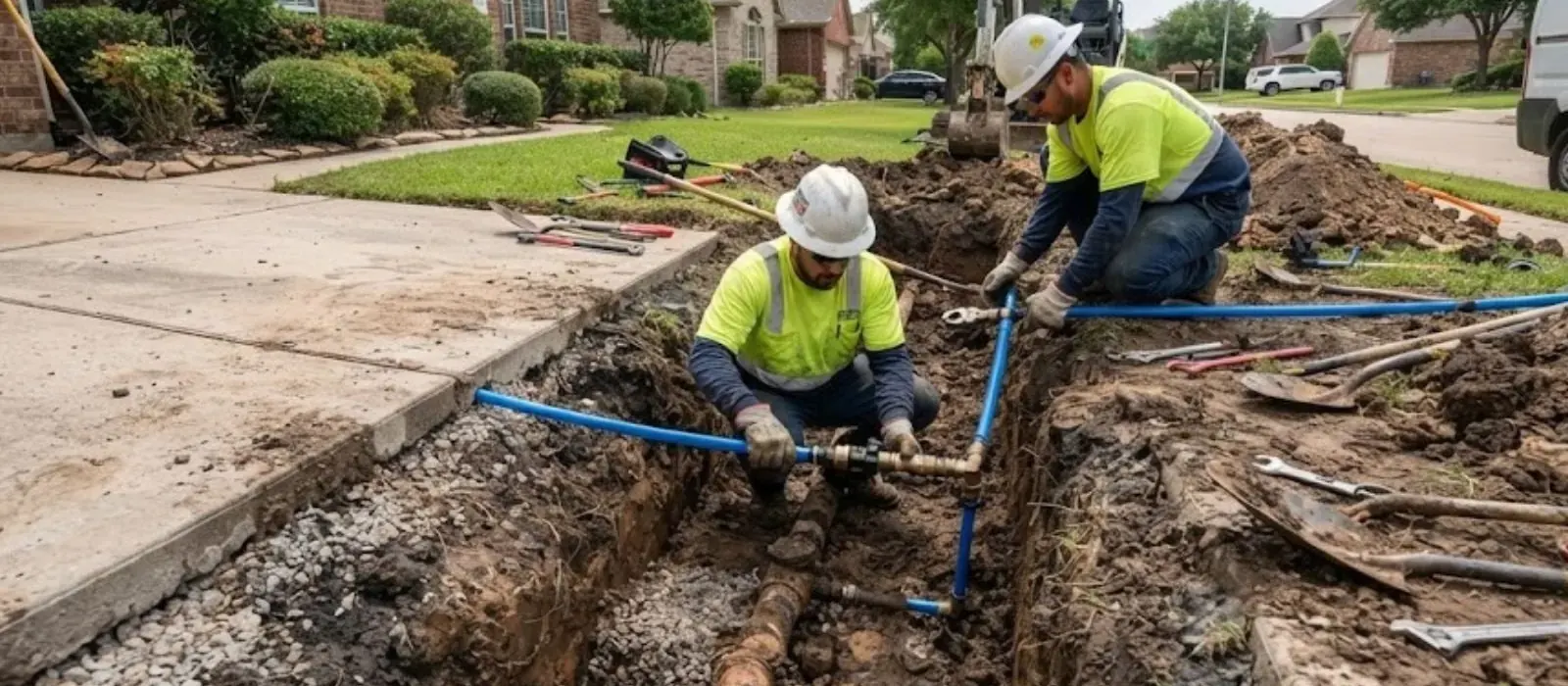
Water line emergency: what to do first
Start inside, not outside. Close the main valve where the line enters the house, then open a hose bib and the lowest faucet to drain pressure. If water is pooling near the foundation or a basement window well, move belongings upward.
Do not dig toward the water yourself. Buried gas, electric and communication lines can sit close to the water service, and Blue Stakes of Utah requires notice before excavation. Our line is open at night and on weekends, and same-day visits are offered when the schedule allows.
How a failing service line announces itself
Most line failures begin small and get noisier. These are the signs people describe, in roughly the order they show up.
- A green, soft or muddy strip of lawn between the meter and the house, even in dry weather.
- A meter dial that keeps moving after every fixture is shut off.
- Pressure that sags at every tap instead of one fixture.
- Cloudy or rust-colored water after pressure drops, as sediment stirs.
- A hissing sound near the point where the line enters the house.
Two or more together make a service line the likely suspect. One alone could be a fixture, a valve or a pressure regulator.
How water reaches a Clearfield house
Clearfield City runs its own water system and buys most of its supply from Weber Basin Water Conservancy District, with city wells filling in at peak demand. Storage totals 10.5 million gallons.
The system is mostly gravity-fed with pressure-regulating valves. One booster pump station serves the Freeport Center and areas south of Antelope Drive. Pressure at your tap is therefore set partly by the city and partly by what sits on your side of the meter, so a plumber reads a gauge at your hose bib before blaming either one.
If neighbors on the same block report the same drop, call the city water department before paying for a diagnosis. If only your house is affected, the cause is usually your line, a failed regulator or a valve.
Source: Clearfield City Public Works, Water Department page.
Permits and code when a water line is replaced
Clearfield City's 2026 design criteria list the 2024 International Plumbing Code as the adopted plumbing code, effective July 1, 2026. The city's permit guidance lists new and replacement plumbing lines as permit work.
That matters for a service line because the dig, the new pipe and the inspection happen in a fixed order. Call 811 before any digging, which Blue Stakes of Utah asks for at least three business days ahead, and ask the plumber who handles the permit.
Water line gushing or the house has no water? Call (801) 207-7520 now and a licensed plumber will take it from there.
Call (801) 207-7520Low water pressure: the line or something else?
Low pressure has many causes, so the first job is to sort them. A plumber puts a gauge on an outdoor spigot and compares it with what comes out of the kitchen faucet.
Low everywhere
A shut or half-open main valve, a sticking pressure regulator, or a corroded or leaking service line can all starve the whole house. If the meter runs while pressure is poor, the line is leaking. If the meter is quiet, look at the regulator and valves first.
Low at one or two fixtures
That points at clogged aerators, a bad cartridge or a partially closed stop valve. Those are small repairs, covered under faucet repair, and not worth a trench.
Low on the hot side only
The problem is in the water heater or its piping. Sediment and corroded fittings are the usual suspects, and the water heater repair page covers that branch.
Finding a buried line leak before digging
The plumber closes the house valve and watches the meter for movement, which proves the leak is outside the house. A pressure test on the line, then a ground microphone swept along the route, picks up the hiss of escaping water. The loudest point marks the dig.
Surface water is a poor guide, because it follows gravel and sand away from the break. A pothole at the loudest spot is smaller, cheaper to restore and safer than chasing a wet patch. Before it opens, 811 must mark buried utilities at least three business days ahead, and the person digging places that request.
Repair or replace: the honest trade-offs
A short repair is attractive when only one section has failed. It is the wrong choice when the line is old, thin-walled or showing several leaks, because the next failure arrives a few feet away.
Spot repair
A small excavation exposes the break, a coupling or new section goes in, and the trench closes. It fits a single failure in a line that is otherwise sound.
Open-trench replacement
The old line comes out and a new one goes in along the same route. It costs more up front, restores the surface, and ends the cycle of repeat repairs.
Trenchless replacement
Where the route and soil suit it, a new line is pulled through from small pits, which protects lawns, driveways and walks. It is not possible everywhere, so the plumber must confirm the route first.
Clearfield lists new and replacement plumbing lines among permit work. Permit rules vary, so ask the Clearfield City building department what applies before the trench is opened.
Matching the fix to the situation
Use this table to frame the conversation with the plumber, not as a final answer.
| Situation | Best option | When it makes sense |
|---|---|---|
| One pinhole or joint failure | Spot repair | Line is otherwise sound and easy to reach |
| Repeat breaks on an old line | Full replacement | Second or third leak on the same run |
| Line crosses a driveway or patio | Trenchless where feasible | Route and soil allow pulling a new pipe |
| Corroded steel inside the house | Repipe the interior | Rust-colored water or weak flow at every tap |
| Pressure low, meter quiet | Regulator or valve work | No leak found, gauge confirms the drop |
Why older Clearfield lines wear out
Census data lists 12,042 homes with a median build year of 1989, and about 987 of them predate 1950. Service lines at those addresses have had the most years in the ground, so a plumber checks the line's age and material before recommending a spot repair.
Frost adds stress. Clearfield's permit criteria list a 30 inch frost line, and the nearest NOAA station shows 121 nights a year at or below 32F. A line that sits shallow, or rises into an unheated garage, takes a beating that deeper runs avoid. Ask the plumber to show you where the line enters and how deep the pit goes.
What drives the cost of a water line job
A clear price comes before work starts. Four to five things decide it.
- Length of the line
- A short run from a meter near the house costs less than a long run across a deep lot.
- Depth and surface above it
- Lawn restores easily. A driveway, sidewalk or patio adds cutting, hauling and patching.
- Pipe material
- Copper, PEX and polyethylene pipe differ in cost and in how they connect to the existing line.
- Soil and obstructions
- Rock, tree roots and crowded utility corridors slow digging and raise labor.
- Permit and locate time
- Replacement lines are permit work in Clearfield, and 811 notice takes three business days.
Insurance often responds to a sudden break inside the house and may not cover a service line that failed from age or corrosion. Some policies add a separate service line endorsement, so check yours before work begins.
A short call settles whether the problem is the line at all. Dial (801) 207-7520.
New lines, additions and garages
Not every water line job is a repair. A line to a detached garage, a basement bathroom or an outdoor spigot is installation work, handled under plumbing installation. New lines are permit work in Clearfield, so the plumber starts by asking what the city expects.
When it is not the water line
A wet yard can come from a sprinkler line, groundwater or a sewer problem, and a gurgling floor drain is a sewer line repair question. If water shows at the street side of the meter, the leak may be the city's, so call Clearfield City Public Works. We cannot dig up the city's main.
For homes in Clinton and Layton the same steps apply, but each city sets its own permit rules.
Water line questions from Clearfield homeowners
Do you handle water line repair emergencies at night or on weekends in Clearfield?
Yes. Our dispatch line is open 24/7 and a licensed plumber is sent for a broken line. No arrival time is promised. Until the plumber arrives, close the main valve inside the house. Keep people away from soaked ground near electrical equipment, and do not dig.
How do I know the leak is in the water line and not in the house?
Shut the main valve inside the house and watch the meter. If it still moves, the leak sits between the meter and the valve, which means the buried line. If it stops, the leak is in the house plumbing.
Who owns the line from the meter to my house in Clearfield?
That boundary is not spelled out on the city pages we reviewed, so ask Clearfield City Public Works where the city's part ends. A plumber can work on the house-side line once the boundary is confirmed.
Can a water line be replaced without tearing up my yard?
Sometimes. Trenchless methods pull a new pipe through from small pits, but they depend on the route, soil and fittings. The plumber checks the route first and tells you honestly if open trench is the better option.
Is low water pressure always a line problem?
No. A partly closed valve, a failing pressure regulator, clogged aerators or a water heater problem can all lower pressure. A gauge reading at the hose bib and a meter check tell the plumber which path to follow.
Do I need a permit to replace a water service line?
Clearfield lists new and replacement plumbing lines among permit work. Whether a small spot repair counts is not stated, so ask the Clearfield City building department before work begins.