
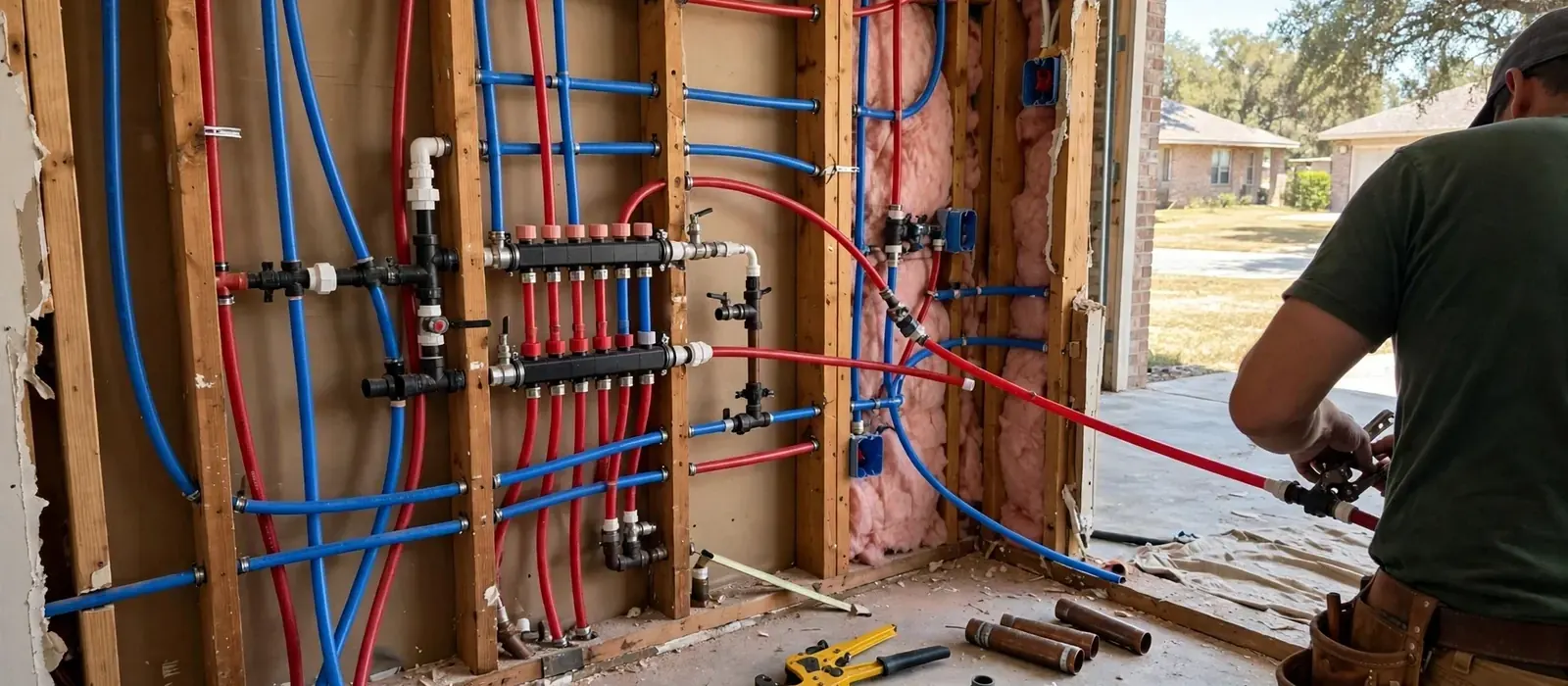
Repipe or repair: the rule we use
One pinhole leak does not condemn a house. Three leaks in a year on the same material, in different rooms, usually do. The pattern matters more than the count, because corrosion works along the whole length of a pipe, not just at the spot that failed.
So the plumber asks three questions. What is the pipe made of? Is the damage local or everywhere? Can the system still deliver pressure to the farthest fixture? Copper that failed once usually earns a local repair. Old steel with rust at several taps and weak flow points toward repiping.
Clearfield's older housing is where the pipe questions begin
Census data for Clearfield shows 12,042 housing units, with a median build year of 1989. About 2,609 of them, roughly 22 percent, went up before 1970, including 322 built in 1939 or earlier and 896 in the 1950s. Another 2,123 date from the 1970s.
The census does not record what the pipes are made of, so a home's age is only a prompt. In older houses that were never updated, galvanized steel supply lines are a common find, and they rust from the inside. Ask the plumber to look at your actual pipe rather than guess from the year. Homes in nearby Roy and Sunset have similar mid-century stock.
Source: U.S. Census Bureau American Community Survey 2020 to 2024, housing units by year structure built, Clearfield city.
How failing supply pipes show themselves
Galvanized steel narrows as rust and mineral scale line the inside wall. You see the effects before you see the pipe. Water runs brown or orange after sitting overnight. A shower that once ran strong fades when someone flushes a toilet. Hot and cold both lose force at the far end of the house.
Old copper tells a different story. Pinholes open in the wall of the tube, often leaving green crust or a damp patch on drywall. Pipe joints weep. A water bill creeps up with no visible puddle.
Before you blame the pipes, rule out the simple things. Check for a pressure regulator near the main shutoff, and ask whether neighbors have low pressure too. The city system is mostly gravity-fed through pressure-regulating valves, and a failing regulator at your own house can mimic bad pipe. For an unexplained wet spot, start with leak detection.
Spot repair, partial repipe or whole-house repipe
This is how the choices compare when the plumber has seen the pipe.
| Condition | Option | When it makes sense |
|---|---|---|
| One leak, rest of system sound | Spot repair | The pipe is otherwise clean and the leak has a clear cause |
| Corrosion in one zone, such as a kitchen run | Partial repipe | Damage is limited and the zone can be isolated |
| Rust at several taps, weak flow throughout | Whole-house repipe | The steel is failing everywhere and repairs only move the problem |
| Repeat pinholes in copper across rooms | Whole-house repipe | The tube wall is thinning in many places |
| Remodel opens the walls anyway | Repipe during the remodel | Access is cheap while drywall is already off |
Pipe that leaks under a slab has its own page. See water line repair for service lines and buried runs.
Code and permits for a whole-house repipe
Clearfield City's 2026 design criteria list the 2024 International Plumbing Code as the adopted plumbing code, effective July 1, 2026. The city's permit guidance lists new and replacement plumbing lines as permit work, so a repipe is not a fixture swap.
Plan on a permit step and ask the plumber to explain the inspection before walls are closed. That order protects you from opening drywall twice.
Want a plumber to look at your pipes before you decide? Call (801) 207-7520 any time.
Call (801) 207-7520What the plumber inspects before quoting a repipe
The visit starts at the main shutoff. The plumber notes the pipe material, checks the pressure with a gauge on a hose bib, and runs several fixtures together to see how flow collapses. A cut-out sample of old pipe shows how much of the bore is left.
Then comes the access question. Basements, crawlspaces and attics allow cleaner routes. Homes on slabs and homes with finished walls take more planning. The plumber maps where each line runs, which walls must open and where the new manifold or trunk lines will sit.
Be aware of what this inspection cannot do. A camera is useful for drain lines but cannot tell you the condition of a pressurized supply pipe inside a wall. Judgment comes from the pipe you can see, the flow tests and the leak history.
PEX or copper: choosing the new pipe
PEX is flexible plastic tubing. It snakes through walls with fewer joints, which means fewer places for a leak and less wall opened. It tolerates a hard freeze better than rigid pipe but is not a reason to leave lines in an unheated space, and it should not sit in direct sunlight.
Copper is rigid and long-proven. It costs more in materials and labor and has more soldered joints, but some owners prefer it for exposed runs.
Either way, a licensed plumber should do the work. Utah law exempts minor repairs from licensing but not work that changes culinary water piping, and Clearfield City's permit list includes new and replacement plumbing lines. Ask the Clearfield City building department what permit applies to your house.
Townhomes, condos and shared stacks
Clearfield has about 1,096 attached single-family homes and more than 2,200 units in buildings of five or more. In those, supply lines may feed more than one unit, and the association often controls what you may open. Get written permission before any wall work.
The plumber can repipe your unit's branch lines but may not be able to touch shared risers. Ask the association who owns each segment.
What drives the cost of a repipe
Every house is different, so we price after we see it. These are the factors that matter.
- Size of the house
- More bathrooms, floors and fixtures mean more pipe and more connections.
- Access
- Open crawlspaces and basements are faster than finished walls or a slab foundation.
- Pipe material
- PEX and copper differ in material cost and in the labor needed to install them.
- Wall and ceiling repair
- Opening drywall is part of the job. Patching is usually separate from finish painting.
- Permit and shutoff work
- Permit review, new shutoff valves and a pressure test are part of doing it right.
Insurance usually pays for sudden and accidental damage, such as a burst pipe, and rarely for corrosion or wear. A repipe done only because the pipes are old is typically not covered. Read your policy or ask your agent.
To talk through your options, call (801) 207-7520 and describe what you see at the taps.
When repiping is not the answer
A repipe renews supply lines only. It does not touch drains, vents or the sewer. A gurgling drain or slow tub points to drain cleaning, not new supply pipe. Low pressure from a failing regulator is cheaper to fix than a house of new tubing.
If a single run bursts, you need burst pipe repair first. That is an emergency, and the dispatch line stays open around the clock.
Repiping questions from Clearfield homeowners
How do I know if my house has galvanized pipes?
Galvanized steel looks dull gray and feels magnetic, and threaded joints are common. Copper is orange-brown and PEX is plastic in red, blue or white. A magnet test at an exposed pipe tells you quickly. The plumber can confirm it during a visit rather than rely on the year the house was built.
Does low water pressure mean I need to repipe?
Not necessarily. A failing pressure regulator, a half-closed valve or a municipal issue can all cut flow. If low pressure shows up at several fixtures along with rusty water, corroded pipe becomes more likely. A pressure reading at an outdoor hose bib is the first test.
How long does a whole-house repipe take?
It depends on house size, access and how much drywall must come open. Many repipes are done in stages so water is back on each evening, but we do not promise a duration before the plumber has seen the house. Ask for a plan covering shutoff times when you get your price.
Do I need a permit to repipe a house in Clearfield?
Clearfield City's permit list says new and replacement plumbing lines need a permit. Specific requirements and inspections vary, so ask the Clearfield City building department what applies to your project. The plumber handles the permit steps for work we perform.
Will insurance pay for repiping?
Usually not when the reason is age or corrosion. Policies tend to cover sudden and accidental water damage, such as a burst line, but not wear and tear. If a pipe failure caused damage, ask your agent whether the resulting damage is covered separately from the pipe itself.
Can you repipe if the water heater is in the garage?
Yes. The plumber reconnects the new lines to the heater and shutoffs with proper fittings. Lines in a cold garage or on an exterior wall need freeze protection. Ogden-area normals show about 28 nights at or below 32 degrees in both December and January.