
Four reasons to put a camera in the lateral
Most people book an inspection because something already feels wrong. Some book it because a large decision is coming and the pipe is the one part nobody can see.
Backups that keep coming back
If a line has been cleared twice and still backs up, the cause is probably structural. Roots in a joint, a sag that holds water or a crushed section will keep catching waste no matter how often the clog is cleared.
Buying a house
A home inspector looks at the house, not the pipe under the yard. A camera run before closing shows whether the seller is handing you a lateral that needs replacing. The pipe is yours the day you own the property, so find out first.
Before you dig or pour
A new driveway, patio or tree planting over an unknown lateral is a gamble. The locator on the camera marks the line and its depth, so you can design around it.
Before a lining or repair quote
No honest quote for lining or replacement exists without footage. The camera tells the crew how long the damaged section is and whether it can be cleaned enough to line.
Clearfield's housing mix and who owns the pipe
Census data for Clearfield counts 12,042 homes, with a median build year of 1989. About 987 of them date from before 1950, roughly 39 percent from before 1980, and 335 from 2020 or later. Age is only a hint about sewer material, so the camera decides, but a pre-1980 house is a sensible first candidate.
North Davis Sewer District's ordinances make the connected property owner responsible for the building sewer, including the connection to the main. That means a buyer inherits the lateral. A camera run before closing is the cheapest way to learn what you are inheriting. We run the same inspections for buyers in Clinton and Syracuse, where the same district rules apply.
Source: U.S. Census Bureau American Community Survey 2020-2024 (housing units by year built) and North Davis Sewer District ordinances adopted October 2025.
How the inspection goes
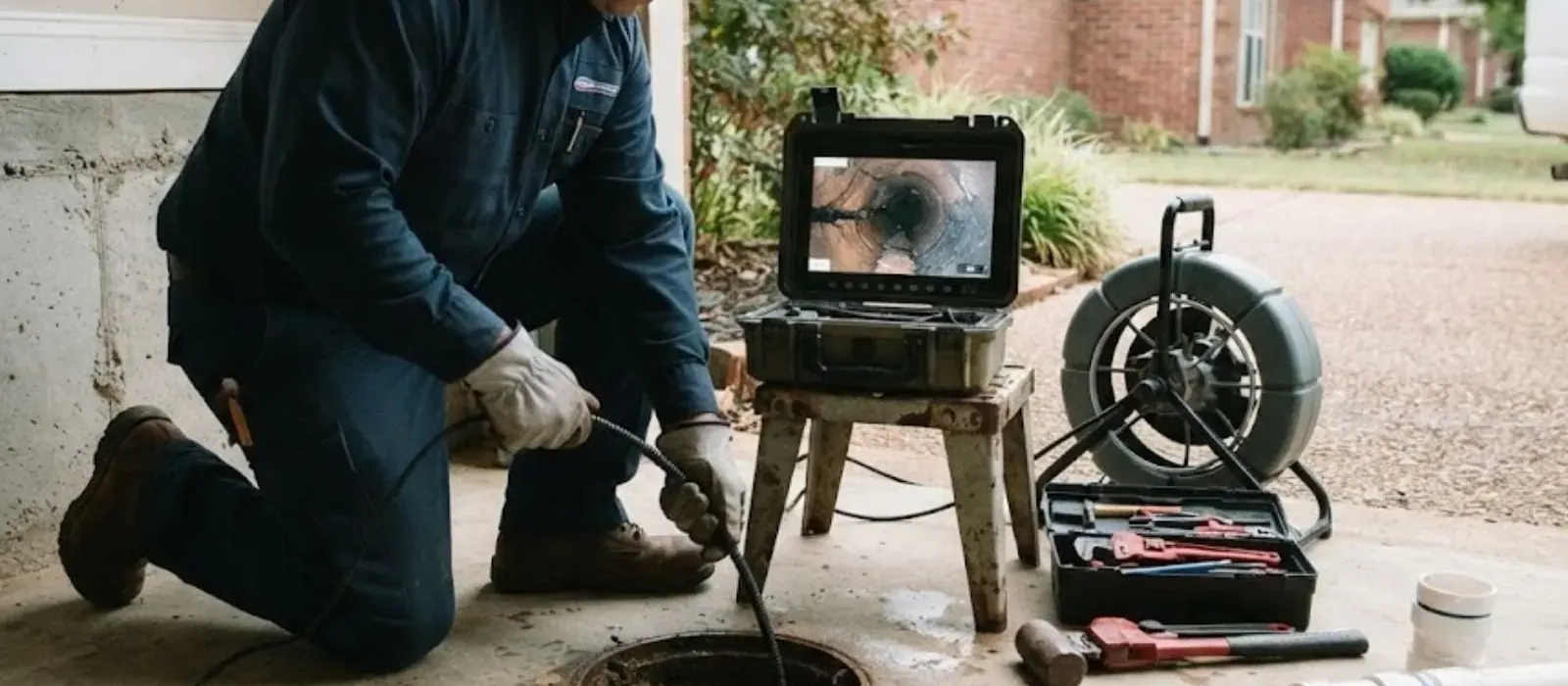
The plumber starts at the cleanout, a capped pipe usually near the foundation or in the basement. If there is none, access comes through a pulled toilet or a roof vent, which takes longer.
A waterproof camera head on a push cable travels down the lateral toward the street. A transmitter inside the head lets a handheld locator pick up a signal at the surface, so any defect can be marked on the ground with its depth. Water is run through the house during the pass to show how the pipe carries flow.
If the line is partly blocked, the plumber may need to clear it before the camera can pass. That is normal, and it is a separate step from the inspection. See sewer line cleaning for how that works.
Reading the monitor: what each image means
The picture is only useful if somebody explains it. Here are the sights a plumber calls out most often.
| On screen | What it usually means | Typical next step |
|---|---|---|
| Pale hairy fibers at a joint | Roots entering the pipe | Cut roots, then repair the joint |
| Joints out of line | Offset or settled pipe | Spot repair if short |
| Standing water ahead | A belly in the pipe | Replace that section |
| Flaky orange scale | Cast iron wearing from inside | Clean, then line or replace |
| Thick white or gray coating | Grease buildup | Jet clean and change habits |
| Smooth clear flow | Pipe is healthy | Keep the footage for later |
A clear camera pass on the day does not rule out a future root problem. It shows the condition now.
Ready to see what is under the yard? Call and book a licensed plumber with a camera.
Call (801) 207-7520What a camera cannot tell you
A camera finds problems inside the pipe, and that is all it finds. It will not locate a leak in a wall, a failing vent or a cracked supply line. It cannot pass a fully collapsed section, so a run that stops short is itself a finding.
It also cannot read a pipe's age, only its material and condition. And a lateral with no accessible cleanout may need a toilet pulled before anything can be inspected. Your plumber should say so up front.
After the footage: your choices
If the pipe is sound, you are done and you have a baseline to compare against in a few years. If it needs work, the findings lead to sewer line repair or to cleaning, depending on whether the problem is the pipe or what is inside it.
A trenchless liner suits a long run of worn pipe, and a dig suits a collapse. Planned digging in Utah requires a Blue Stakes of Utah notice at 811 at least three business days ahead. Clearfield City also lists replacement plumbing lines as permit work, so ask the building department what applies.
Grease shows up on camera more often than anyone expects. For a heavily coated pipe, a hydro jetting pass cleans the walls so the recorded pass is clearer.
What shapes the cost of a camera inspection
An inspection is a smaller job than a repair, but the same few factors set its price.
- Access to the line
- A cleanout makes the pass quick. Pulling a toilet or going through a roof vent adds time.
- Length and depth of the run
- A short lateral to a close main takes less time than a long run to the street.
- Cleaning beforehand
- A partly blocked line has to be cleared first, and that is priced separately.
- Locating and marking
- Pinpointing a defect on the surface takes more time than a straight look.
- Reporting needs
- Footage and notes for a home purchase or an insurance claim take more effort than a quick look.
Insurance rarely pays for an inspection by itself, because it is diagnosis rather than damage. If a covered loss is already in play, your insurer may ask for the footage, so keep it. Read your policy or ask your agent.
You get a clear price before work starts. Call (801) 207-7520 to schedule.
Questions about sewer camera inspections
How long does a sewer camera inspection take?
It depends on the length of the lateral, how easy the access is and whether the pipe needs cleaning first. A clean line with a cleanout is the quick case. A long run with roots takes longer. The plumber can tell you what to expect once they see the cleanout.
Should I get a sewer scope before buying a home in Clearfield?
Yes, if the house is older or the seller cannot say when the line was last checked. North Davis Sewer District's ordinances make the property owner responsible for the building sewer, so the repair bill becomes yours. Ask for cleanout access before your contract deadline.
Can the camera tell me whether my pipe is cast iron, clay or plastic?
Usually, yes. Cast iron looks rough and scaled, clay shows short sections with joints every few feet, and plastic is smooth with a uniform color. An unusual mix can also appear where a past owner repaired part of the line.
Do I need to be home during the inspection?
Someone should be there to give access to the cleanout and answer questions about past backups. The plumber will show you the monitor. Seeing it yourself makes the repair conversation much easier.
Will running a camera damage an old pipe?
A push camera is gentle, and it rides through the pipe without scraping. A badly weakened line can still shift when anything moves through it. The plumber will stop if the pipe looks too fragile and tell you why.
Does a sewer inspection need a permit in Clearfield?
A camera run involves no digging and no new pipe, so it is diagnosis rather than construction. Repairs are different. Clearfield City lists replacement plumbing lines as permit work, and permit rules vary, so ask the Clearfield City building department before you plan one.
Can I get a copy of the footage?
Ask when you book. The recording and the plumber's notes are useful for a repair quote, an insurance claim or a purchase negotiation. Keep both somewhere safe, since a dated recording is hard to argue with later.